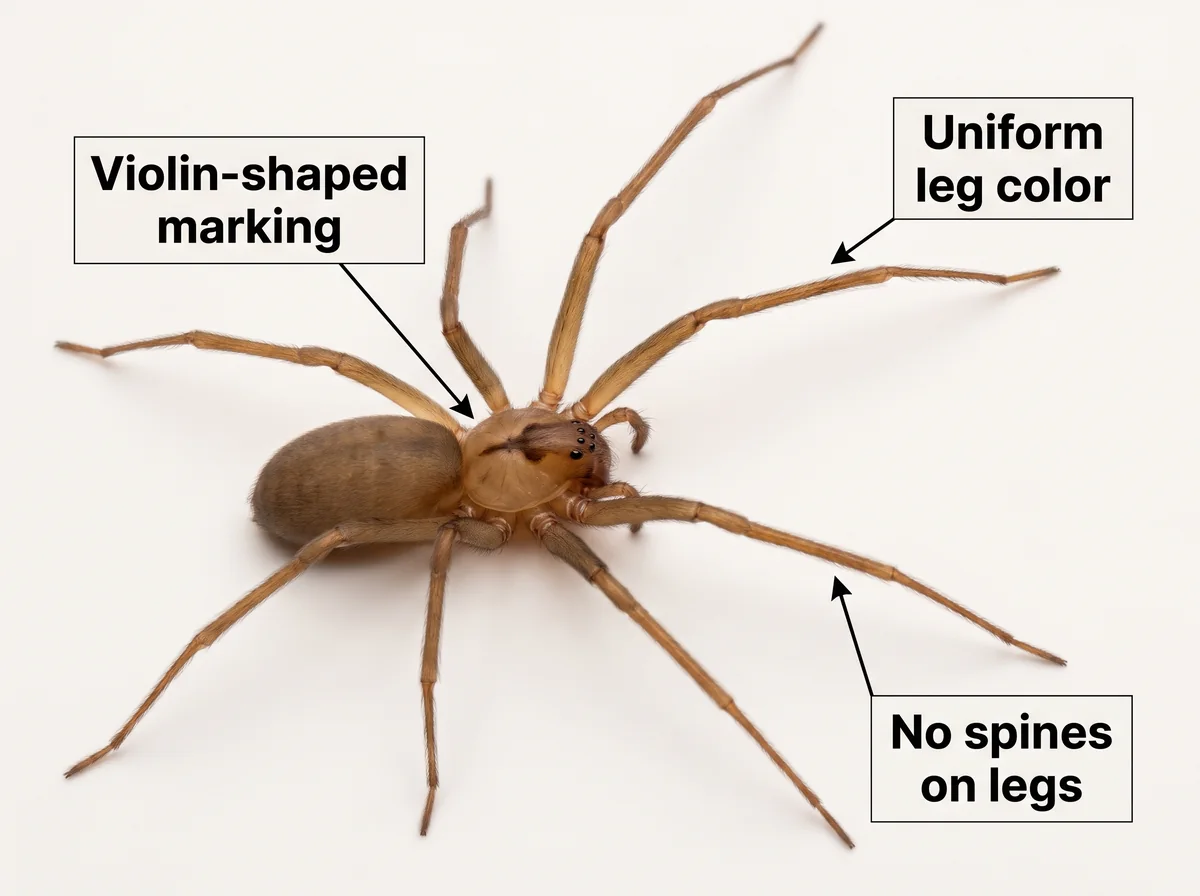
Quick identification facts
Brown Recluse Identification Checklist
Review these ten visual and regional field marks to evaluate whether a spider matches the characteristics of a brown recluse.
How Do You Check the Eyes?
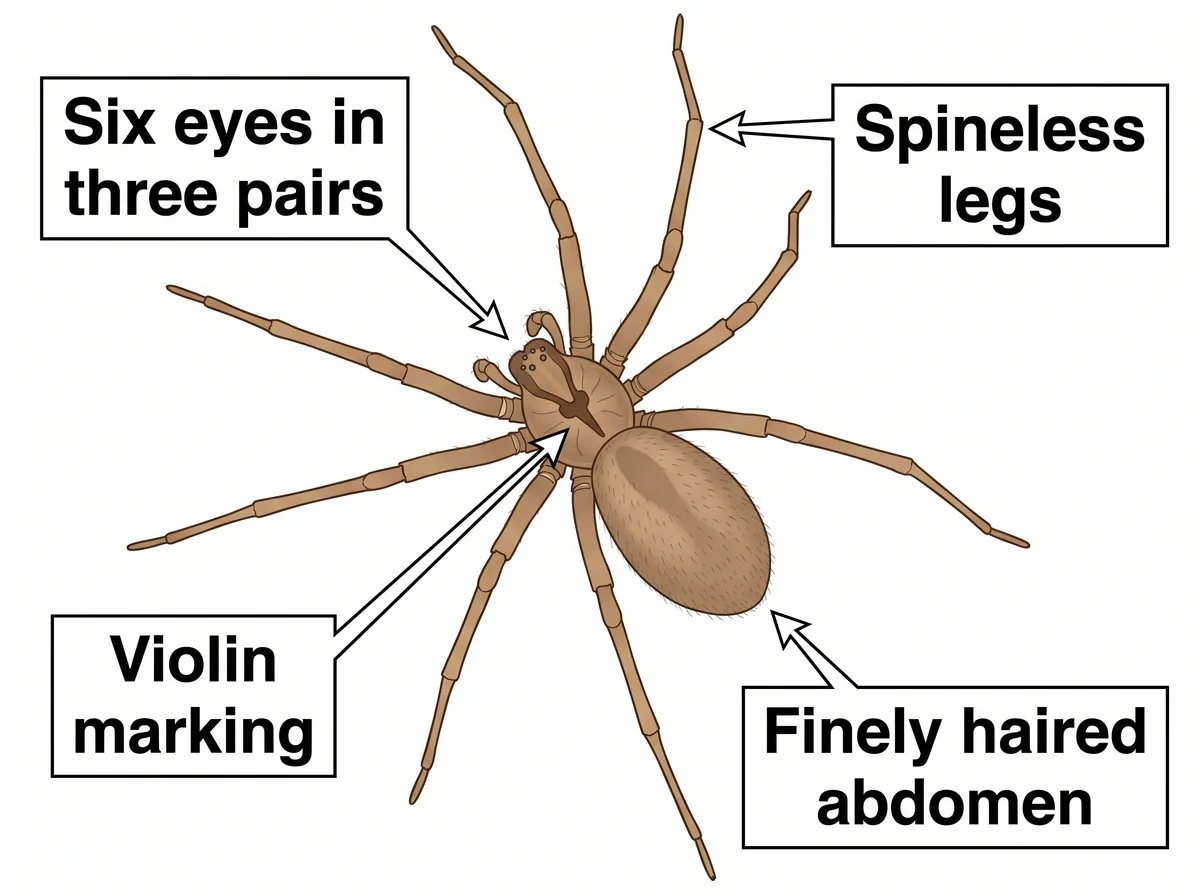
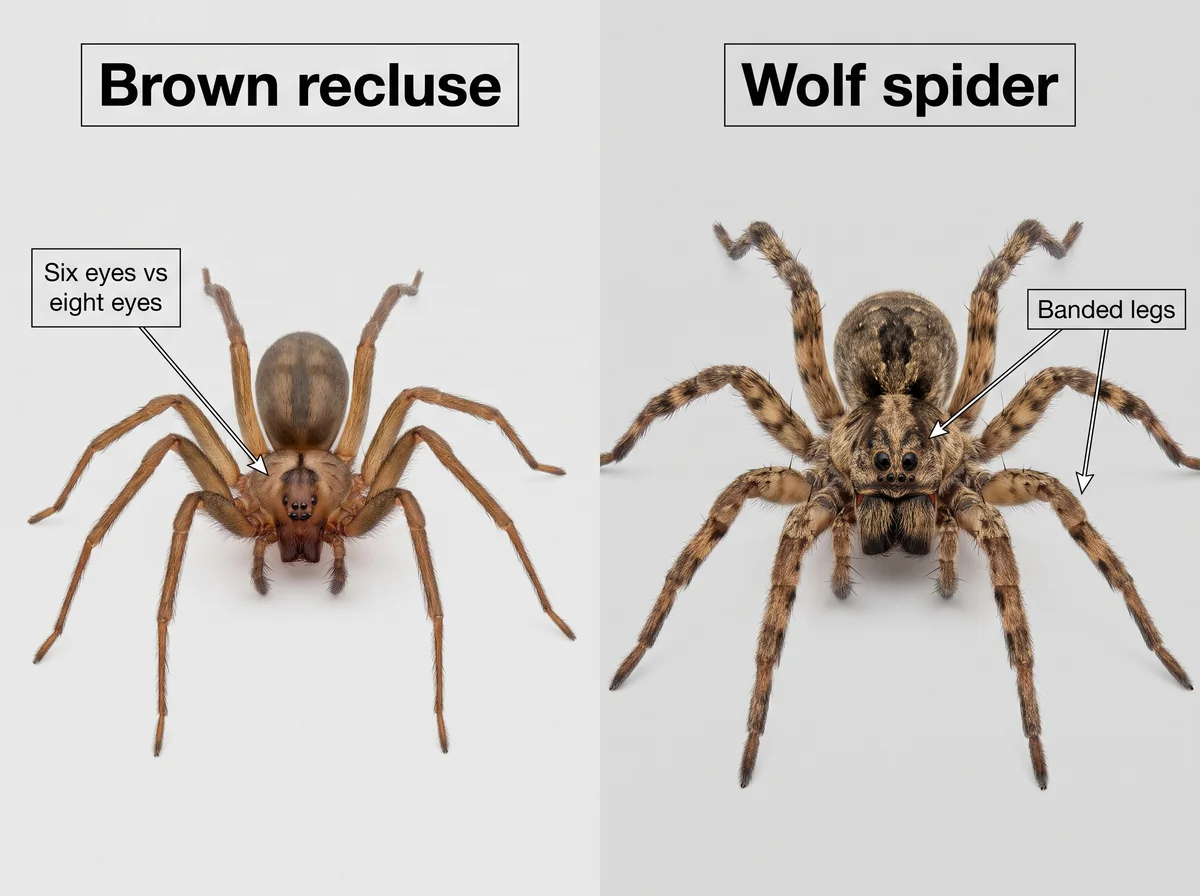
Most spiders you find around your home have eight eyes arranged in two horizontal rows across their face. A brown recluse has only six eyes. These eyes are grouped into three distinct pairs, known as dyads, that form a small semicircle across the front of the cephalothorax.
Because the violin marking on the back can vary in darkness or fade on younger specimens, checking the eye arrangement gives you the most dependable diagnostic clue. You will need a bright light and close magnification to see these three pairs clearly.
- Look for six total eyes instead of eight
- Confirm the eyes sit in three distinct pairs
- Observe the curved semicircle layout across the head area
If your photo still leaves you unsure, check the visible clues with BugKnow for another side-by-side comparison.
What Does the Violin Marking Look Like?
The famous violin marking sits directly on the cephalothorax, which is the fused head and midsection of the spider. The wider base of the violin shape starts near the eye cluster, while the narrow neck points straight back toward your spider's abdomen.
Contrast levels on this marking vary between individual spiders. Fully grown adults tend to have a more distinct, darker pattern, while younger spiders often display a faint, light outline. The body beneath the mark remains an even tan or light brown.
- Wide base begins directly behind the eyes
- Narrow neck points backward toward the rear body segment
- Color is darker than the surrounding tan or brown head region
Are the Legs and Abdomen Patterned?
A genuine brown recluse has solid, uniform coloration across its entire abdomen and all eight legs. You will never see mottling, distinct rings, dark spots, or colored stripes on these parts of the spider.
When you examine the legs, you will see they are long, slender, and coated in very fine, soft hairs. They lack thick, prominent spines or stiff bristles that stand out to the naked eye. If you notice thick spikes, bright bands, or geometric patterns on the legs, you are looking at a different species entirely.
- Solid tan or dark brown abdomen with zero spots
- Plain legs without bands, rings, or color breaks
- Slender legs covered in fine hairs rather than sharp spines
How Big Is an Adult Brown Recluse?
The body of a mature brown recluse measures roughly one-quarter to one-half inch long, which equals about 6 to 11 millimeters. When the spider stands naturally with its long legs extended, its total span is roughly the size of a standard U.S. quarter.
Size can also tell you something about the spider's sex. Male brown recluses are generally about half the size of females. Younger, immature spiders share the same general proportions and body outline as mature adults, but you will notice their coloring is lighter.
- Adult body length spans 1/4 to 1/2 inch without legs
- Total leg span covers the diameter of a U.S. quarter
- Males are typically about half the size of mature females
You can also submit a clear snapshot to identify an insect from a photo and verify distinctive eye arrangements.
Where Do They Live Inside and Outdoors?
The established native range of the brown recluse covers a defined region of the United States. This area stretches from southeastern Nebraska across to southwestern Ohio, reaching south down into northwestern Georgia and across into Texas. Findings outside this core native range are exceedingly rare.
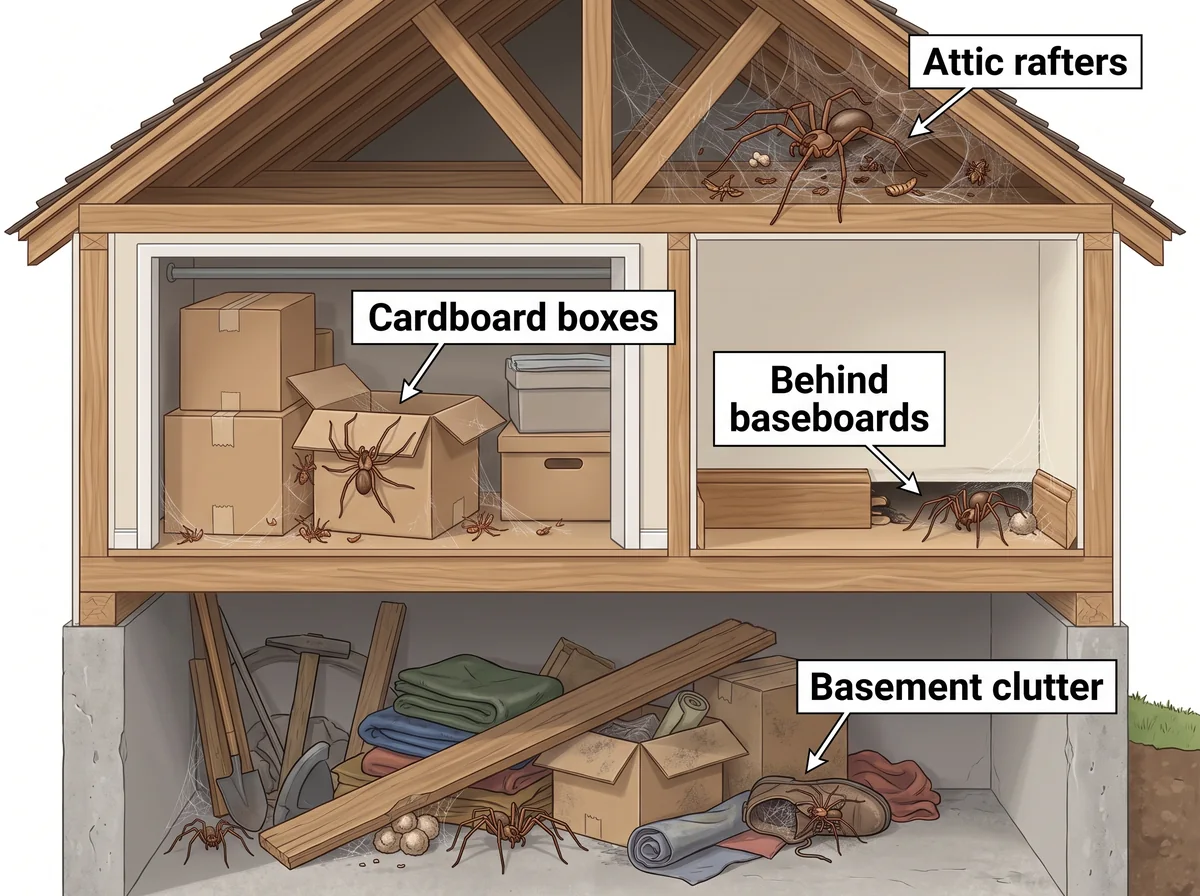
Other related Loxosceles recluse species live across the southwestern United States and southern California, but the true brown recluse species is not native there. Indoors, these spiders seek out quiet, dark, and undisturbed shelters. You might encounter them inside your attic, unfinished basement, dark closets, and cardboard storage boxes, where they hide in crevices by day and roam at night.
- Native range spans the central and south-central United States
- Finds outside the established native range are exceedingly rare
- Prefers undisturbed indoor spots like storage boxes and closets
Which Look-Alikes Cause the Most Confusion?
Several common household spiders are regularly mistaken for a brown recluse because of their brown coloring or similar proportions. Comparing specific body markings and leg textures helps you rule them out quickly.
The southern house spider shares a similar color scheme and often lives in the same indoor structures, but you can see it possesses eight eyes and lacks the distinct violin shape. Wolf spiders feature thick, robust legs with prominent hairs and dark patterns, while woodlouse hunter spiders display a smooth, bright reddish-brown cephalothorax and pale abdomen without any violin shape.
- Southern house spider: Eight eyes and lacks a dark violin marking
- Wolf spider: Heavier body, patterned markings, and bristled legs
- Woodlouse hunter spider: Reddish-brown head, pale body, and no markings
What Happens During a Bite and How Is It Managed?
Brown recluse bites are frequently over-diagnosed compared to other common causes of skin sores. The initial bite is usually painless, so you might not notice it happening right away. Within the first hour, a localized burning sensation can develop, followed by a small pimple or fluid-filled blister within 6 to 12 hours.
Not every bite turns into an open ulcer. In more severe cases, the tissue around the bite site may darken and form an ulcerated sore over the course of 10 to 14 days. Significant wounds typically take 6 to 8 weeks to heal and can leave a scar. There is no widely available antivenom in the United States, so medical treatment focuses on supportive wound care and preventing bacterial infections. Rare systemic complications, like hemolytic anemia, have been documented, but serious illness or death remains rare.
- Painless initial bite followed by burning within an hour
- Small pimple or blister may appear in 6 to 12 hours
- Healing takes 6 to 8 weeks for significant wounds
- Treatment focuses on supportive wound care and infection prevention
If you need immediate help checking a spider in your home, use Insectio spider identifier to compare your photo against key visual field marks.
Look-alike Comparator
Compare distinguishing physical features between the brown recluse and common look-alike species found in similar habitats.
Is It Harmful?
Evaluate bite progression indicators and physical symptoms associated with suspected brown recluse encounters.
Explore the complete Brown Recluse guide
What Does a Brown Recluse Look Like?
confirm identity of a specific spider by physical traits
appearanceBrown Recluse Size: How Big Is It?
understand actual dimensions and scale
comparisonBrown Recluse vs Wolf Spider: What's the Difference?
distinguish two specific commonly confused spiders
comparisonBrown Recluse vs House Spider: What's the Difference?
distinguish brown recluse from common indoor house spiders
comparisonBrown Recluse Look Alikes: What Could It Be Confused With?
broadly identify which other spiders get confused with a brown recluse
habitatBrown Recluse Habitat and Range: Where Does It Live?
learn geographic range and native habitat
signsBrown Recluse in Your House: Why Is It There?
practical indoor inspection to confirm or rule out presence
life cycleBrown Recluse Life Cycle: How Does It Develop?
understand developmental stages and timing
eggsBrown Recluse Egg Sac: What Does It Look Like?
identify a found egg sac
appearanceBaby Brown Recluse Identification: What Does It Look Like?
identify a juvenile/spiderling specimen and understand its risk
harmBrown Recluse Bite Symptoms and Stages: What Should You Watch For?
identify and track the visual progression of a suspected bite
harmIs a Brown Recluse Dangerous?
gauge overall risk level and separate fact from exaggeration
harmBrown Recluse Bite Treatment: What Should You Do?
find evidence-based first-aid and medical-care steps
preventionBrown Recluse Bite Prevention: How Can You Avoid It?
learn behavioral precautions to reduce bite risk
signsSigns of Brown Recluse Infestation: What Should You Look For?
determine whether multiple spiders/an established population is present, and next steps
signsBrown Recluse Web Identification: What Does It Look Like?
identify a spider by its web structure
faqBrown Recluse FAQ: What Do People Ask Most?
get short direct answers to miscellaneous one-off questions
Frequently asked questions
How can you tell a brown recluse from a regular brown spider?
You can tell them apart by checking the eyes, markings, and legs. A brown recluse has six eyes in three pairs and an even body color without stripes. Most common brown spiders have eight eyes in two rows, spiny legs, and patterned or spotted abdomens.
Where are brown recluse spiders naturally found in the United States?
They are native to a region extending from southeastern Nebraska to southwestern Ohio, south to northwestern Georgia and Texas. Encounters outside this defined area are exceedingly rare, though related recluse species inhabit the desert southwest.
Do all brown recluse spiders have a dark violin on their back?
Most adults feature a visible dark violin marking behind their eyes with the neck pointing toward the abdomen. However, the contrast varies, and the mark can be faint on young spiders, making the six-eye pattern the most reliable feature.
What does a brown recluse bite look like in the first 24 hours?
The bite is usually painless initially. Within an hour, localized burning may start, developing into a small pimple or blister between 6 and 12 hours. Severe reactions may begin to darken over subsequent days, though not all bites form ulcers.
Are baby brown recluse spiders dangerous or easy to identify?
Immature brown recluses share the same general body shape as adults but have lighter coloration and less distinct violin marks. You can still look for their six eyes, solid leg coloring, and lack of spines to separate them from other spiderlings.
What is the medical treatment for a confirmed brown recluse bite?
There is no antivenom available in the United States for brown recluse bites. Medical care is supportive, focusing on cleaning the wound, managing local symptoms, and preventing infection while the tissue heals over several weeks.