Quick identification facts
Habitat and Range Quick Checker
Use this checklist to evaluate whether your location and discovery site match the confirmed habits of the brown recluse spider.
Which States Fall Within the Established Native Range?
The brown recluse spider has an established native range centered across the south-central and Midwestern United States. If you map this area, it runs from southeastern Nebraska across to southwestern Ohio, south to northwestern Georgia, and extends directly into Texas. Within these geographic borders, the species finds shelter easily in natural settings as well as inside homes, outbuildings, and commercial buildings.
When you look at regional records, you can see that breeding populations thrive throughout central states like Missouri, Arkansas, Tennessee, and Kentucky. Spiders easily survive winter by sheltering inside heated buildings or quiet outdoor crevices. If you reside in this core geographic region, encountering a genuine brown recluse in undisturbed storage areas is a regular possibility that homeowners learn to manage.
Checking your home state against this known map gives you immediate clarity on your risk. When people suspect they found a brown recluse in far northern, eastern, or western states, clear physical checks almost always reveal a common local species. True brown recluse populations remain tightly restricted to this defined central belt where climate conditions support their year-round life cycle.
- Northern limits reach southeastern Nebraska, southern Iowa, Illinois, Indiana, and southwestern Ohio.
- Southern and western edges cover Arkansas, Missouri, Tennessee, Kentucky, Alabama, Mississippi, Louisiana, and Texas.
- Eastern boundary tapers off sharply in northwestern Georgia.
For the next useful comparison, see Brown Recluse in Your House: Why Is It There?.
How Rare Are Recluse Sightings Outside This Region?
Occurrences of brown recluse spiders outside their established native range are considered exceedingly rare by entomologists. Individual spiders can hitchhike inside moving boxes, furniture, or commercial cargo shipments into distant states, but these solitary travelers do not establish lasting populations. You should not assume a brown spider found in distant northern or coastal states represents a breeding infestation.
Related Loxosceles recluse species occur in the southwestern United States and southern California, but Loxosceles reclusa itself is not native to those areas. These western desert species stay adapted to arid open landscapes rather than human dwellings. If you live in California or Arizona and spot a recluse, it belongs to a different regional desert species entirely.
Examining field marks helps you evaluate any unfamiliar spider before you assume the worst. Almost all suspected brown recluse specimens submitted to university labs outside the Midwest turn out to be harmless native spiders. Knowing how unusual a true recluse is outside the central states saves you time and prevents unnecessary home chemical treatments.
- Non-native occurrences represent isolated transport rather than established populations.
- Southwestern states host distinct, related Loxosceles species rather than Loxosceles reclusa.
- Suspected specimens in northern and western states are usually misidentified look-alikes.
A related clue is covered in Brown Recluse Web Identification: What Does It Look Like?.
To compare this detail with another source, Insectio’s brown recluse spiders habitat page offers a useful cross-check.
Where Do Brown Recluse Spiders Hide Indoors?
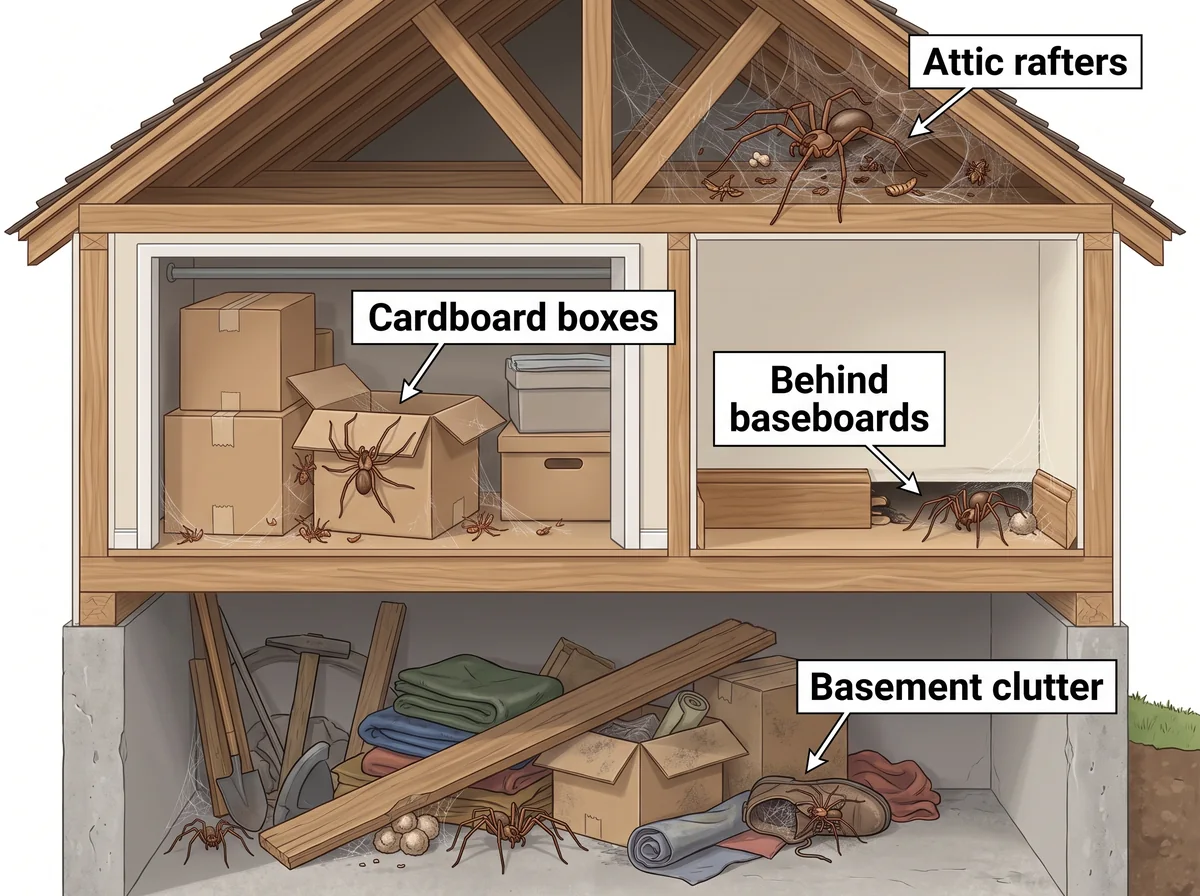
Indoors, brown recluse spiders favor quiet, dark, undisturbed areas such as attics, basements, closets, and stored boxes. You will rarely find them sitting in the middle of bright living rooms or walking across open kitchen counters. Instead, they seek out dark, narrow gaps where human foot traffic is low and their resting spaces remain undisturbed.
Stored cardboard boxes provide ideal indoor shelter because the corrugated layers offer dark, dry hiding slots that protect the spiders from light. When you unpack seasonal decorations, old books, or stored clothing, take time to check folds and flaps carefully. The spiders slide into flat spaces behind baseboards, under furniture, or inside undisturbed wall framing during daylight hours.
These spiders do not construct large circular webs out in the open to capture flying insects. You will only find small, irregular patches of silk near their secluded daytime resting spots. Keeping your storage spaces clean, using sealed plastic storage bins, and reducing floor clutter helps you eliminate the dry crevices they rely on indoors.
- Attics, basements, crawlspaces, and closets offer primary shelter.
- Stored cardboard boxes and folded linens create favored indoor microhabitats.
- Narrow crevices behind furniture and baseboards serve as daytime resting sites.
You can check the same detail against Brown Recluse Life Cycle: How Does It Develop?.
Why Are Recluses Active Mainly at Night?
Brown recluse spiders are active mainly at night and hide in dark crevices and hollows during the day. As darkness falls, they leave their daytime hiding spots to search for small insect prey across floors and walls. Because they avoid light, you will rarely spot them wandering around your home during normal daytime hours.
Most human contact occurs late at night or early in the morning when people switch on lights in dark rooms or reach into storage. A foraging spider may crawl into shoes, laundry piles, or folded bedding left on the floor overnight to rest. When you pick up those items in the morning, the spider can become trapped against bare skin.
These spiders have a reclusive nature and naturally run away from disturbance rather than acting aggressively. They only bite when accidentally pinched or squeezed against human skin inside clothing or bedding. Shaking out your shoes and hanging up clothes prevents accidental contact if you live where these spiders are common.
- Daily activity happens predominantly during nighttime hours.
- Daytime hours are spent concealed in dark, narrow voids and hollows.
- Nighttime foraging occasionally leads spiders into clothing, bedding, or shoes.
This also connects with Brown Recluse Egg Sac: What Does It Look Like?.
Can You Distinguish Recluses From Look-Alike Spiders?
Several common indoor spiders share dark resting spots with the brown recluse, which causes frequent misidentification among homeowners. The Southern House Spider builds dense webs around wall cracks, while Wolf Spiders hunt across basement floors. Woodlouse Hunter Spiders also hide under dark objects in basements, leading people to mistake their brown bodies for a recluse.
You can separate look-alikes by checking the eyes and body patterns closely. Adult brown recluse spiders have six eyes arranged in three pairs in a semicircle, unlike most spiders which have eight eyes in two rows. Wolf spiders have eight eyes and noticeable dark stripes on their back, making them easy to tell apart under good light.
Check the legs and body color whenever you find a spider in your home. A brown recluse has uniformly colored legs without dark bands, stripes, or large spines. If the spider you find shows banded legs, dark body spots, or eight eyes, you can be confident it is a harmless look-alike rather than a brown recluse.
- Southern house spiders inhabit similar indoor corners but lack the six-eye dyad pattern.
- Wolf spiders feature distinct dorsal patterns and eight eyes in three rows.
- Woodlouse hunters possess large, prominent jaws and smooth, reddish cephalothoraxes.
For the next useful comparison, see Baby Brown Recluse Identification: What Does It Look Like?.
Related identification guides
Brown Recluse in Your House: Why Is It There?
practical indoor inspection to confirm or rule out presence
life cycleBrown Recluse Life Cycle: How Does It Develop?
understand developmental stages and timing
eggsBrown Recluse Egg Sac: What Does It Look Like?
identify a found egg sac
signsBrown Recluse Web Identification: What Does It Look Like?
identify a spider by its web structure
Frequently asked questions
Are brown recluse spiders common in California or Florida?
Brown recluse spiders are not native to California or Florida, and verified finds in both states are exceedingly rare. California hosts related native recluse species within the Loxosceles genus, but not Loxosceles reclusa itself. In Florida, confirmed records represent isolated instances of accidental human transport in luggage or shipping boxes. If you find a brown spider in either state, you are looking at a common local look-alike such as a southern house spider or wolf spider.
Where should you check for brown recluse spiders inside an attic or basement?
Focus your search on quiet, dark, undisturbed spots. Check inside and behind stored cardboard boxes, under floorboards, along dark framing corners, and behind stored furniture. Brown recluses hide during daylight hours inside dry, narrow crevices and wall hollows where they stay undisturbed. Use a bright flashlight to inspect seams and box flaps, because these spiders avoid open, well-lit spaces and prefer to remain concealed in tight hiding spots throughout your basement or attic.
Do brown recluse spiders live outdoors as well as indoors?
Yes, within their native range, brown recluse spiders live outdoors in quiet, dry shelters. You can find them hiding under loose tree bark, beneath flat rocks, inside woodpiles, and in dry outdoor sheds. They prefer narrow spaces that shelter them from weather and predators during the day. However, indoor attics and basements offer steady temperatures and abundant insect food, which is why brown recluses readily establish shelter inside human dwellings across their home range.
How can you tell if a spider found in your home is actually a brown recluse?
To identify a brown recluse, look closely at its physical features. A true brown recluse has uniformly colored legs with no dark stripes, bands, or large spines. Its body ranges from tan to dark brown with a dark violin marking on the cephalothorax. The most reliable diagnostic feature is its eye pattern: brown recluses have six eyes arranged in three pairs forming a semicircle, whereas almost all common home look-alikes have eight eyes in two rows.