Quick identification facts
Egg Sac Identification Checklist
Use these visual checks to determine whether a silk sac you discovered matches the profile of a brown recluse.
What Color and Texture Is the Silk?
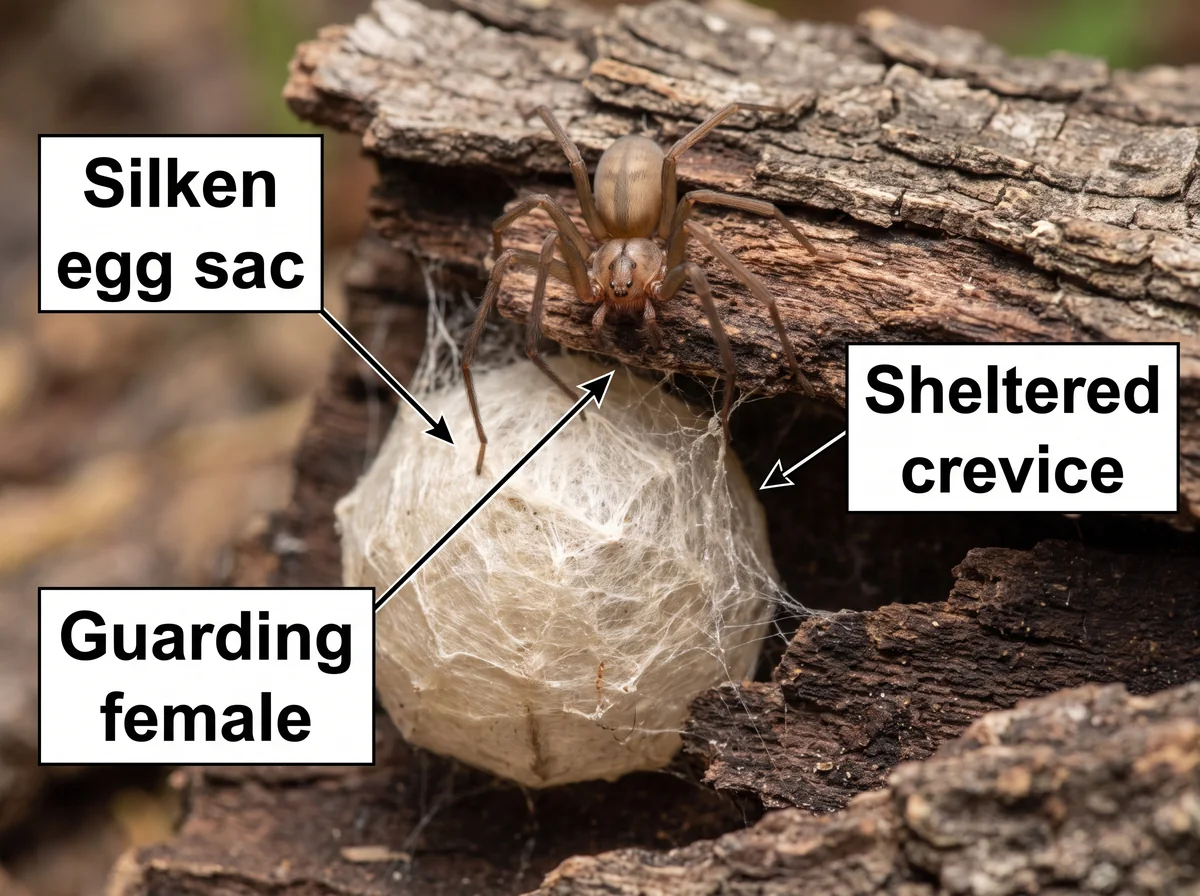
When you look at a brown recluse egg sac, you will notice that the silk appears off-white or grayish rather than bright snowy white. The outer layer is thin, flat, and somewhat translucent. You can often see the faint, pebbled outline of the individual eggs resting beneath the loose silk threads.
The overall structure does not look like a neat, tight ball. Instead, it forms a flattened disc or lens shape that the female attaches directly to a surface. The silk feels soft and papery rather than tough or leathery, and it lacks the dense, smooth covering found on some garden spider sacs.
You will usually spot loose strands of irregular web surrounding the sac. The brown recluse does not spin organized geometric webs to catch prey. The silk you see around the egg sac serves mostly as an anchor and a light protective cushion to hold the structure firmly against a flat surface.
- Off-white to soft grayish silk coloring
- Flattened, disc-like profile instead of a round sphere
- Translucent covering that often reveals egg shapes inside
For another part of the identification, open Brown Recluse Life Cycle: How Does It Develop?.
Where Does the Female Place the Sac?
A female brown recluse chooses quiet, dark spots that remain undisturbed for months at a time. If you inspect storage areas, look along the seams of cardboard boxes, beneath stored lumber, or behind baseboards. She prefers narrow crevices where the sac stays protected from physical disturbance and temperature shifts.
Inside living areas, you might find an egg sac tucked into the folds of stored clothing, behind rarely moved furniture, or under utility closet shelving. The spider pins the flat sac against flat wood, paper, or drywall rather than suspending it in the middle of an open room or window frame.
The female often stays near her eggs to guard them until they hatch. If you gently shine a flashlight into a recessed gap and spot a sac, you may see the adult female resting within a few inches. She remains close by throughout the incubation period to protect the developing clutch.
- Hidden seams inside corrugated cardboard boxes
- Dark crevices behind wall paneling, baseboards, and furniture
- Sheltered corners in closets, crawl spaces, and attics
For another set of photos and notes, Insectio’s brown recluse appearance page is worth comparing.
How Many Eggs Are Inside Each Sac?
Each egg sac generally contains roughly 40 to 50 eggs, though smaller clutches of about 20 eggs are also common. The eggs are tiny, round, and pale. Because the silk envelope is quite thin, the cluster forms a compact, slightly bumpy layer across the center of the flattened disc.
Over the course of her lifetime, a single female typically produces one to five egg sacs. Most of this reproduction occurs during the warmer months, especially from May through July. Each sac represents a distinct generation that develops independently over the course of several weeks.
Because one female can construct multiple sacs in a single season, you might find several small discs clustered in the same secluded harbor. Even if older sacs are already empty, their presence tells you that mature spiders have successfully nested in that specific part of the building.
- Roughly 20 to 50 pale eggs in every pouch
- One female can lay between one and five sacs over her life
- Active egg production peaks between May and July
A related clue is covered in Baby Brown Recluse Identification: What Does It Look Like?.
How Long Does It Take for Spiderlings to Hatch?
Eggs typically hatch in about one month, with emerging spiderlings appearing between 24 and 36 days after the female spins the sac. Temperature and humidity influence the exact pace of development, but the young generally emerge before late summer when eggs are laid during peak season.
When the tiny spiderlings leave the sac, they resemble miniature adults in body shape but show a much lighter tan coloration. They stay clustered near the torn sac for a brief period before dispersing into nearby cracks and voids to hunt tiny insects independently.
After emerging, the young spiders grow slowly compared to many common household pests. They molt five to eight times over roughly 10 to 12 months before reaching full reproductive maturity. In total, adult brown recluse spiders can live an average of 2 to 4 years.
- Incubation lasts roughly 24 to 36 days from laying
- Spiderlings molt 5 to 8 times across 10 to 12 months
- Adults maintain an average lifespan of 2 to 4 years
How Do You Tell It Apart from Look-Alike Sacs?
Other common indoor spiders create egg sacs that look quite different once you examine their shape and placement. For example, the southern house spider constructs a more tangled, web-heavy retreat in corners, while the woodlouse hunter spider uses dense, white silk cells under outdoor debris.
Wolf spiders do not attach their egg sacs to walls or boxes at all. If you see a spider carrying a neat, round, spherical silk ball attached directly to her spinnerets, you are looking at a wolf spider rather than a brown recluse, which always deposits her sac on a surface.
Look closely at the surrounding silk and structure to make a confident call. A brown recluse sac is always stationary, flat, and sheltered within a crevice. If the sac is spherical, suspended on a neat spiral web, or carried on the spider's body, you can rule out the brown recluse.
- Wolf spider females carry round sacs on their bodies
- Southern house spiders create dense webbing in open corners
- Brown recluse sacs are stationary, flat discs in deep crevices
You can check the same detail against Brown Recluse in Your House: Why Is It There?.
Related identification guides
Brown Recluse in Your House: Why Is It There?
practical indoor inspection to confirm or rule out presence
life cycleBrown Recluse Life Cycle: How Does It Develop?
understand developmental stages and timing
appearanceBaby Brown Recluse Identification: What Does It Look Like?
identify a juvenile/spiderling specimen and understand its risk
harmBrown Recluse Bite Symptoms and Stages: What Should You Watch For?
identify and track the visual progression of a suspected bite
Frequently asked questions
Can you identify a brown recluse just by looking at the egg sac?
A flattened, off-white silk disc in a dark crevice provides a strong clue, but you cannot confirm the species with certainty from silk alone. Look for an adult spider nearby to check diagnostic traits. Adult brown recluse spiders have six eyes arranged in three pairs in a semicircle and uniformly colored legs without dark bands or prominent spines.
What should you do if you find an egg sac in your home?
Use a flashlight to check the surrounding area carefully, taking care not to place your bare hands into unlit crevices. You can remove the sac using a vacuum hose attachment or seal it inside a disposable container. Wearing work gloves protects your hands if a guarding female rests nearby in the same dark recess.
Do brown recluse spiders carry their egg sacs around?
No, a brown recluse never carries her egg sac after laying it. The female permanently glues the flattened silk pouch to a quiet surface such as cardboard, wood framing, or wall voids. If you observe a spider actively carrying a white or grayish silk ball on her abdomen, it is a wolf spider.
Are baby brown recluse spiders dangerous when they hatch?
Newly emerged spiderlings are extremely small, pale, and fragile. While they possess venom like adults, their tiny mouthparts are generally incapable of puncturing human skin. However, finding newly hatched spiderlings confirms that a breeding population is present indoors, which means mature adult spiders are likely active in nearby secluded spaces.