Quick identification facts
House Spider vs Brown Recluse Field Checker
Use this step-by-step checklist to examine the physical features of your indoor spider and see if its traits match a brown recluse or a common house spider.
How Do the Eyes Reveal the Difference?
Your clearest confirmation comes down to counting eyes under good lighting. Most spiders you spot around windows or ceiling corners have eight eyes arranged in two straight or curved rows. A brown recluse has only six eyes grouped into three distinct pairs, known as dyads, forming a neat semicircle across the front of the head region.
Getting a clear view of these three pairs usually requires a magnifying glass or a sharp smartphone photo. You will see one pair directly in the center and one pair sitting on each side, leaving an open space between the groups. This arrangement remains consistent across both mature spiders and lighter-colored young recluses.
Relying solely on color or shape can easily mislead you because several harmless indoor species share a similar tan or brown hue. When you examine the face directly, the absence of an eight-eye cluster immediately helps you eliminate common house spiders. If the spider has eight eyes in two stacked rows, you can quickly rule out a recluse.
- Six eyes arranged in three distinct pairs in a semicircle.
- One central pair with two separate lateral pairs.
- Most common house spiders possess eight eyes in two rows.
You can check the same detail against Brown Recluse vs Wolf Spider: What's the Difference?.
What Markings Set the Bodies Apart?
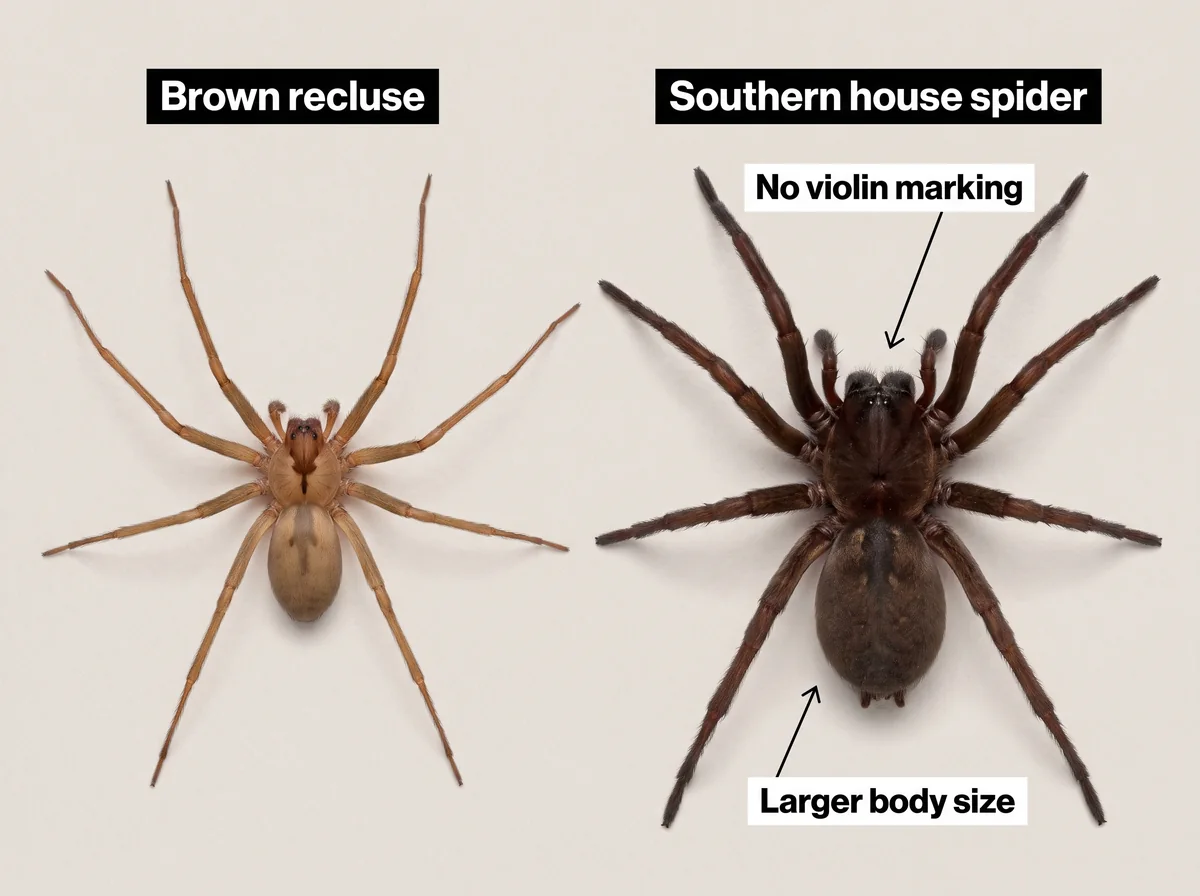
Look closely at the spider's upper body section, called the cephalothorax, behind the eyes. A brown recluse typically displays a dark violin- or fiddle-shaped marking positioned flat on top. The wider base of the violin sits right behind the eyes, while the thinner neck points straight back toward the abdomen.
You should also check the abdomen itself for any contrasting color patterns. A brown recluse has an abdomen of solid, uniform color ranging from tan to dark brown, completely free of spots, chevron stripes, or blotches. In contrast, common house spiders frequently show mottled patches, dark marbling, or distinct light-and-dark streaks across their bodies.
Keep in mind that younger recluses often have fainter violin markings that blend more softly into their lighter base color. Because the contrast of this pattern can vary depending on the individual, you should always verify the solid abdomen alongside the eye pattern rather than trusting the violin shape by itself.
- Dark violin marking on the cephalothorax with the neck pointing backward.
- Solid tan or dark brown abdomen with no spots, bands, or chevrons.
- House spiders often feature mottled, marbled, or patterned abdomens.
If you want a second reference, BugKnow’s brown recluse vs. house spider page covers the same topic from another angle.
How Do Leg Patterns and Textures Differ?
Inspect the legs from the joint where they meet the body all the way down to the tips. A brown recluse features long, thin legs that maintain a completely uniform tan or brown color throughout their length. You will not find dark rings, banding, or alternating color segments on any of the eight legs.
The texture of the legs also provides an important field mark you can observe. Brown recluse legs are covered in tiny, fine hairs that give them a smooth, delicate look rather than a bristly surface. They lack the large, upright, conspicuous spines that you commonly see sticking out from the legs of funnel weavers, wolf spiders, and house spiders.
When you see banded legs with alternating light and dark rings, you are looking at a different indoor species entirely. Many harmless cobweb weavers and cellar spiders have prominent stripes or dark knee joints. If your specimen has striped legs or thick, spiky bristles, it is not a brown recluse.
- Uniformly colored legs without stripes, spots, or bands.
- Fine, smooth hairs without prominent upright spines.
- Leg banding indicates a different common house spider.
For the next useful comparison, see Brown Recluse Look Alikes: What Could It Be Confused With?.
Which Look-Alikes Cause the Most Confusion?
The southern house spider is one of the most common species mistaken for a brown recluse inside homes. Male southern house spiders share a similar slender build, long legs, and pale brown coloration, and they often wander across walls in search of mates. However, they have eight eyes gathered in a single compact cluster rather than three separated pairs.
Wolf spiders and woodlouse hunter spiders are also frequently confused with recluses due to their ground-dwelling habits and brownish tones. Wolf spiders feature much heavier bodies, distinct striping, and eight prominent eyes, while woodlouse hunters have bright reddish-orange heads and large, projecting jaws that look completely different from a recluse's smooth brown body.
Take a moment to photograph any specimen resting on a wall or floor before attempting to move it. Comparing the overall color uniformity, eye grouping, and head shape against these known look-alikes helps you identify the creature accurately without guessing based on general size alone.
- Southern house spider males have eight clustered eyes and long palps.
- Wolf spiders display prominent stripes, stout bodies, and heavy leg spines.
- Woodlouse hunters have reddish-orange front sections and large jaws.
What Do the Webs and Signs Tell You?
You can learn a great deal by observing where and how the spider builds its webbing. Brown recluse spiders do not spin neat, symmetrical orb webs or high ceiling cobwebs to catch flying insects. Instead, their webs are loose, messy, and irregular sheets built strictly for resting and hiding.
Check quiet, dark places close to the ground, such as behind baseboards, under stored boxes, or along floorboards inside utility spaces. You might also discover shed skins, known as exuviae, left behind in undisturbed corners. These discarded skins retain the distinct six-eye arrangement, allowing you to check for active recluse presence without finding a live spider.
If you see a classic spiral wheel web suspended in a doorway, or a tangled cobweb high up near your ceiling corners, you are looking at ordinary house spiders. Recluses prefer secluded ground-level retreats and rely on active wandering rather than aerial snares to locate their prey.
- Messy, off-white, irregular retreat webs placed in hidden spots.
- Webbing located low to the floor, behind baseboards, or under storage.
- Shed skins in undisturbed spaces can confirm the eye pattern.
For the next useful comparison, see Brown Recluse Web Identification: What Does It Look Like?.
Related identification guides
Brown Recluse vs Wolf Spider: What's the Difference?
distinguish two specific commonly confused spiders
comparisonBrown Recluse Look Alikes: What Could It Be Confused With?
broadly identify which other spiders get confused with a brown recluse
habitatBrown Recluse Habitat and Range: Where Does It Live?
learn geographic range and native habitat
signsBrown Recluse Web Identification: What Does It Look Like?
identify a spider by its web structure
Frequently asked questions
Can I tell a brown recluse from a house spider by size alone?
Size alone is not a reliable way to separate a brown recluse from a house spider. While an adult brown recluse measures roughly the size of a U.S. quarter with its legs extended, many common indoor spiders share this exact size range. You need to examine specific physical features like eye arrangement, solid leg coloration, and body markings to confirm the identification.
Do brown recluse spiders make webs high up in ceiling corners?
Brown recluse spiders rarely build webs high up in open ceiling corners. They prefer quiet, dark, ground-level locations such as behind baseboards, under furniture, or inside undisturbed storage boxes. Their webs are irregular, messy retreats rather than large aerial nets. Webs found high in open room corners typically belong to common house spiders or cellar spiders.
Why do people often mistake southern house spiders for brown recluses?
Male southern house spiders share a very similar light brown color, slender body shape, and long legs, leading to frequent confusion when they wander indoors. However, you can distinguish them by checking their eyes and legs. Southern house spiders have eight eyes clustered tightly together on a small raised bump, long prominent mouthparts, and lack the distinctive six-eye semicircle.
What is the single most reliable feature for identifying a brown recluse?
The eye arrangement is the most reliable feature for confirming a brown recluse. Unlike most common house spiders that possess eight eyes in two rows, a brown recluse has only six eyes arranged in three distinct pairs forming a semicircle. Because violin markings can vary in contrast, entomologists use this unique eye pattern as the definitive diagnostic mark.