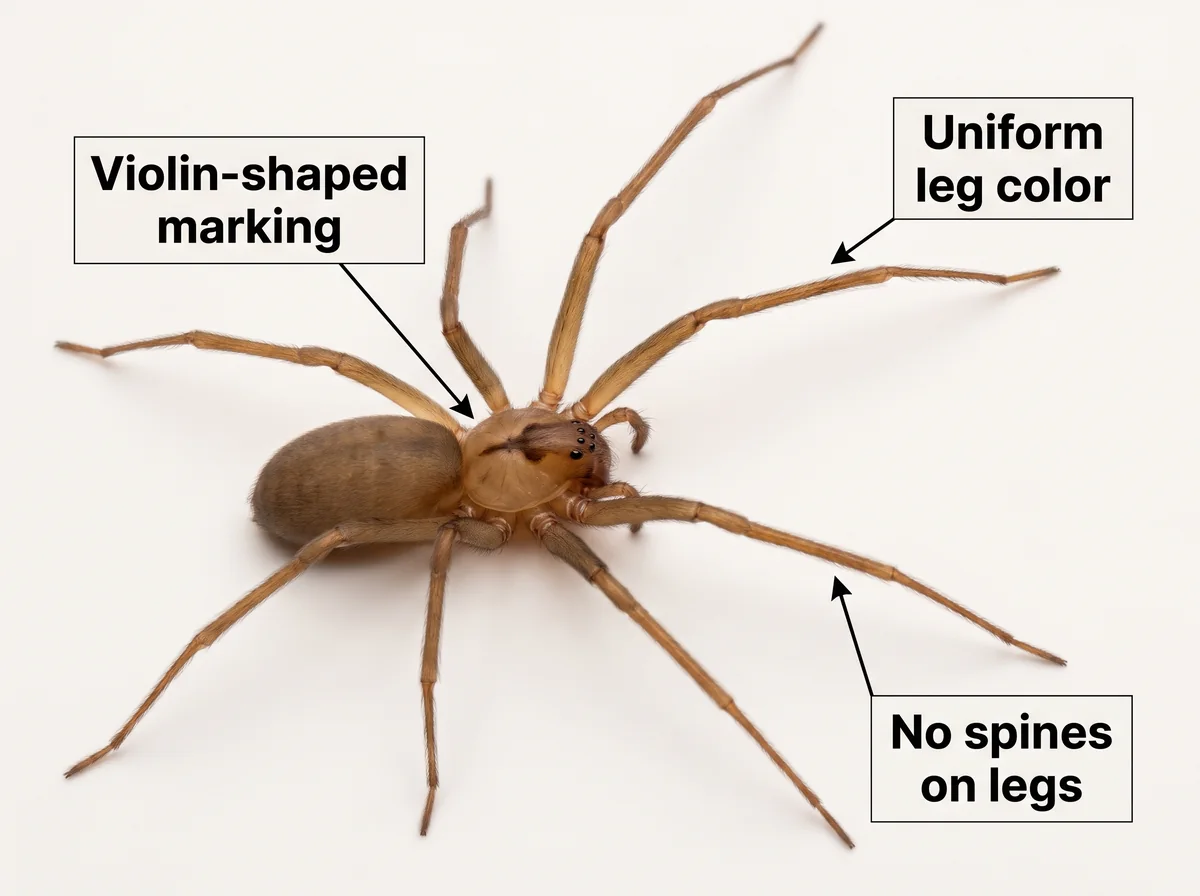
Quick identification facts
Brown Recluse Size & Scale Checker
Use these visual checks to determine if the spider you found matches the exact size and physical proportions of an adult brown recluse.
What Are the Exact Body Dimensions?
When you look at an adult brown recluse without considering its legs, the body measures roughly 1/4 to 1/2 inch long. Entomologists record this length as roughly 6 to 11 millimeters across standard adult populations. Measuring just the body gives you an accurate baseline because leg postures can shift depending on whether the spider is resting or moving.
You will notice the body consists of two main sections: the front cephalothorax and the rear abdomen. The overall body color ranges from tan to dark brown, providing an even backdrop for its subtle markings. Mature females often reach the upper end of the body spectrum, sometimes measuring between 10 and 15 millimeters when fully grown.
Because these spiders are relatively compact, people often overestimate their true body size when startled. If you spot a specimen whose body alone exceeds half an inch, you are almost certainly looking at a completely different spider species. Keeping these exact millimeter measurements in mind helps you rule out larger common household invaders right away.
- Cephalothorax and abdomen combined span 6 to 11 mm.
- Mature females can reach 10 to 15 mm in body length.
- Body color stays consistently within the tan to dark brown range.
For another part of the identification, open What Does a Brown Recluse Look Like?.
How Does Leg Span Compare to a Quarter?
A fully grown brown recluse with its legs spread out naturally covers about the same area as a U.S. quarter. This coin reference gives you a fast, reliable way to judge total scale without needing a ruler. The long, slender legs radiate outward in a loose stance, making the spider appear slightly broader than its small body suggests.
Your visual check of the legs should focus on their structure and solid color. The legs are notably thin and covered with fine, delicate hairs rather than thick, heavy spines. Unlike many outdoor species that display rings or stripes, a brown recluse has uniformly colored legs that match the general tan or brown tone of its body.
Placing a coin near a resting or trapped specimen provides immediate perspective on its total footprint. If the spider spans significantly wider than a quarter or features thick, heavily barbed legs, you can comfortably set aside concerns about a brown recluse. This simple size benchmark eliminates most false alarms in homes.
- Extended leg span matches the diameter of a U.S. quarter.
- Legs are thin, elongated, and covered only in fine hairs.
- Solid leg coloration lacks dark bands, rings, or stripes.
You can check the same detail against Baby Brown Recluse Identification: What Does It Look Like?.
For another set of photos and notes, Insectio’s brown recluse size page is worth comparing.
Why Are Males Smaller Than Females?
Male brown recluses are generally about half the size of their female counterparts in total body mass. While a mature female displays a plumper abdomen measuring up to 15 millimeters, a male carries a much leaner profile. You will see this size difference clearly if you ever observe both sexes side by side in a collection.
Despite their smaller bodies, male recluses maintain proportionally long, thin legs that allow them to travel actively. The lighter weight of the male gives it a delicate, spindly silhouette when it walks across flat surfaces. Both sexes maintain the same uniform tan to dark brown color across their legs and smooth, unpatterned abdominal segments.
Understanding this sexual dimorphism prevents confusion when you encounter smaller adult specimens in dark corners. A tiny brown spider is not automatically a juvenile; it may simply be an adult male searching for shelter. Checking for other physical traits alongside size ensures you identify the spider correctly regardless of its sex.
- Adult males are roughly half the physical size of females.
- Males feature a narrower, lighter abdomen with long legs.
- Both sexes share uniform coloring without spots or mottling.
You can check the same detail against Brown Recluse vs Wolf Spider: What's the Difference?.
How Do Young Spiderlings Compare in Size?
Immature brown recluse spiders are tiny versions of the adults, often measuring only a fraction of their mature size. When you inspect a young spiderling, you will notice that it shares the same general body proportions and thin legs as fully developed specimens. However, their total length is substantially smaller than a quarter.
Coloration is one of the clearest indicators of an immature recluse when you evaluate scale. Younger spiders tend to have noticeably lighter coloring across their entire bodies compared to darker mature adults. Their pale tan bodies can make them harder to spot against light surfaces, though their physical shape remains identical throughout development.
You might also find that the characteristic violin-shaped marking on the cephalothorax is less distinct on very small juveniles. Because contrast varies with age, relying solely on size or faint markings can be tricky. You should always look closely at the eye configuration to confirm the identity of any small, light-colored specimen.
- Spiderlings measure only a few millimeters across during early growth.
- Immature bodies display significantly lighter tan coloration.
- The dark violin mark may appear faint on younger specimens.
You can check the same detail against Brown Recluse vs House Spider: What's the Difference?.
Which Size Clues Rule Out Look-Alikes?
Many common spiders found indoors are mistaken for brown recluses simply because their size is misunderstood. For instance, species like the Wolf Spider often grow noticeably larger than a U.S. quarter and possess bulky, robust bodies. If you encounter a heavy-bodied spider with thick legs, its size alone rules out a recluse.
Other look-alikes, such as the Southern House Spider and the Woodlouse Hunter Spider, present different scale and texture profiles. Southern House Spiders can match or exceed the recluse in span, but their dense body coverings differ sharply. Woodlouse Hunters feature bright reddish bodies and distinct jaws that never align with the uniform tan recluse.
Whenever you evaluate a specimen, check that the body lacks stripes, bands, or spots alongside the proper quarter-sized footprint. A true brown recluse never displays mottled patterns or heavy spiny projections on its limbs. Comparing these precise size and pattern details ensures you separate benign household visitors from genuine brown recluses.
- Wolf spiders are much larger and thicker than a quarter.
- Uniform tan coloring eliminates mottled look-alike species.
- Absence of heavy spines separates recluses from other house spiders.
For the next useful comparison, see Brown Recluse Look Alikes: What Could It Be Confused With?.
Related identification guides
What Does a Brown Recluse Look Like?
confirm identity of a specific spider by physical traits
comparisonBrown Recluse vs Wolf Spider: What's the Difference?
distinguish two specific commonly confused spiders
comparisonBrown Recluse vs House Spider: What's the Difference?
distinguish brown recluse from common indoor house spiders
appearanceBaby Brown Recluse Identification: What Does It Look Like?
identify a juvenile/spiderling specimen and understand its risk
Frequently asked questions
Can a brown recluse spider grow larger than a quarter?
No, a brown recluse does not grow larger than a standard U.S. quarter when you include its extended legs. The body itself tops out at roughly 1/2 inch, or up to 15 millimeters for large females. If you discover a spider in your home that spans significantly wider than a quarter or features a thick, bulky frame, you are looking at a different species such as a wolf spider.
Are male brown recluse spiders the same size as females?
Male brown recluse spiders are distinctly smaller than females, usually measuring about half their overall body size. While both sexes possess long, thin legs and share the same uniform tan to dark brown color, the male features a notably slender, compact abdomen. When you spot a smaller adult spider with the classic recluse proportions, it is frequently a mature male rather than a different species.
How small is a newly emerged brown recluse spiderling?
Young brown recluse spiderlings are tiny, measuring only a few millimeters across when they first emerge. They share the same general body shape and elongated legs as adult spiders, but their overall color is much lighter tan. At this early stage, their dark violin marking may be faint or barely visible, making eye arrangement the most reliable way to identify them as they grow.
What is the easiest way to measure a spider safely?
You can safely check a spider's scale by trapping it beneath a clear container and placing a U.S. quarter next to the glass. This allows you to compare the body length and leg span directly against the coin without getting too close. An adult brown recluse body should measure under 1/2 inch, with its thin legs neatly fitting the quarter's general footprint.