Quick identification facts
Web Structure & Location Checklist
Check the visible traits of the spider web and its location to evaluate if it matches a brown recluse retreat.
How Does a Brown Recluse Web Differ from Other Webs?
When you look at spider silk around your home, the overall shape tells you a lot about the builder. Brown recluse spiders do not spin the classic, spiral wheel webs associated with common garden spiders. Their webs appear distinctly disorganized, loose, and haphazard, lacking any symmetrical framework, spiral patterns, or neat geometric anchor lines across open spaces.
The silk itself forms a dense, messy mat that functions primarily as a private daytime shelter. Because brown recluse spiders hunt actively at night, they do not rely on large, suspended aerial nets to capture flying insects. You will see an off-white, uneven sheet of silk that simply serves as a quiet retreat to hide in until night falls.
If you discover a neat, circular web hanging between high ceiling beams or stretched across an open window frame, you can rule out a brown recluse. Those orderly structures belong to web-building families like orb weavers. A recluse web is consistently tucked away, staying close to solid surfaces where the spider can tuck itself out of view.
- Irregular, tangled silk pattern with no central hub or spiral rings
- Built purely as a protective daytime hiding retreat
- Never spun across high, open aerial gaps like window frames
For another part of the identification, open Brown Recluse in Your House: Why Is It There?.
Where Do Recluse Spiders Typically Spin Their Retreats?
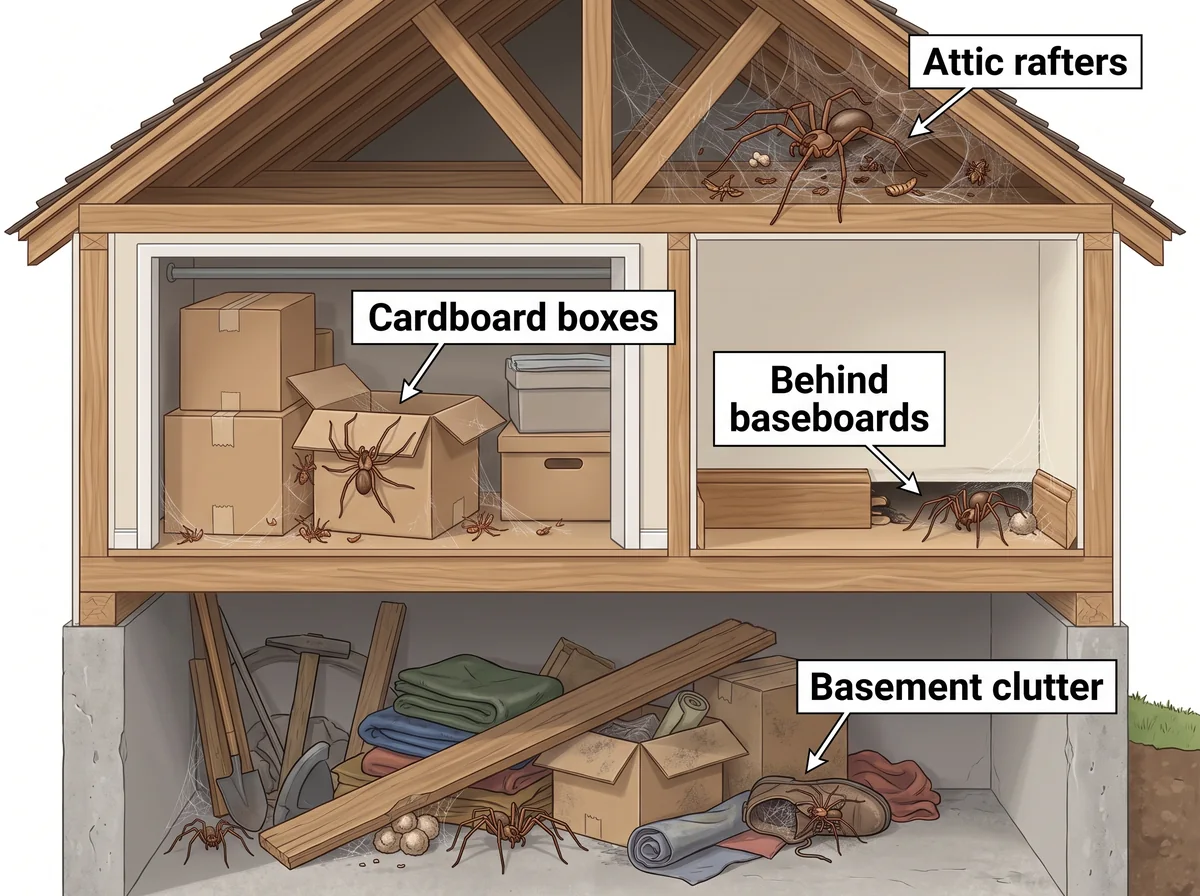
You will usually spot these messy webs built very low to the ground or placed flat against a wall in secluded spots. Indoors, brown recluse spiders favor quiet, dark, undisturbed areas such as attics, basements, closets, and stored boxes. The web acts as an anchor point inside dark crevices, under floorboards, or between cardboard flaps where normal household activity rarely reaches.
Because these spiders avoid light and vibrations, their retreats remain hidden from plain view during the day. You are far more likely to encounter the silk when moving old storage bins, sorting through stacks of lumber, or clearing out long-forgotten corners of a crawlspace. The web connects the spider's hiding crack directly to the adjacent floor or wall surface.
Outdoor locations follow the exact same rule of quiet concealment. Within their native range, recluses hide their disorderly silk inside dry hollows, under loose tree bark, or beneath flat rocks resting against the ground. They consistently choose dark, dry wall gaps and cracks over damp or brightly illuminated exterior walls.
- Hidden along baseboards, floor crevices, and behind stored boxes
- Common in quiet attics, dark basements, and rarely used closets
- Tucked under outdoor debris, flat rocks, and loose tree bark
For the next useful comparison, see Brown Recluse vs House Spider: What's the Difference?.
To compare this detail with another source, Insectio’s brown recluse appearance page offers a useful cross-check.
What Other Clues Appear Around the Web?
Finding an irregular web is only one clue; you should also check nearby surfaces for shed skins, which entomologists call exuviae. As immature spiders grow, they molt their rigid outer layer and leave it behind in their shelter. The presence of shed skins in undisturbed areas can indicate an active brown recluse population sharing those quiet cracks and wall gaps.
A discarded skin often stays fully intact, retaining the spider's general body shape and long, thin legs. Because the molt dries out rapidly in dark spaces, you can sometimes see the faint outlines of the body without encountering a live spider. Finding several shed skins together indicates that spiders have occupied that protected hiding spot for an extended period.
Inspect the surrounding area carefully with a flashlight if you suspect an infestation in your storage area. Recluses hide in dark crevices and hollows during the day and venture out only after dark to search for food. A collection of messy webbing paired with multiple shed skins provides strong evidence of an established indoor shelter.
- Intact shed skins (exuviae) left behind in dark storage spaces
- Multiple molts indicating long-term shelter use in quiet corners
- Hollow crevices nearby where spiders rest until nighttime activity
Why Can Web Structure Alone Mislead You?
While a messy web provides a helpful starting point, it is not definitive on its own. Several common household spiders also build irregular or tangled retreats in dark corners. Spiders like the southern house spider or various cobweb builders create disorganized silk mats in attics and crawlspaces that look remarkably similar to a brown recluse shelter at first glance.
Other active hunters, including wolf spiders and woodlouse hunter spiders, might also wander through dark basements and storage areas where messy webbing exists. Misidentifying a harmless indoor spider is very common when relying solely on silk patterns. Woodlouse hunters and funnel weavers are frequently mistaken for recluses based on general body color and hiding locations.
Because silk patterns overlap across many species, you must look closely at the spider itself rather than trusting the web alone. To confirm you have a brown recluse, you must examine the eye arrangement, ideally with magnification. You cannot confirm the presence of this specific species without verifying its physical body marks.
- Several harmless indoor spiders construct similar messy silk tangles
- Hunting spiders often wander into areas containing old, abandoned webs
- Definitive species confirmation always requires checking physical body traits
For the next useful comparison, see Signs of Brown Recluse Infestation: What Should You Look For?.
What Body Marks Confirm a Spider Near the Web?
If you spot a spider resting near an irregular web, examine its eyes and markings before jumping to conclusions. Adult brown recluse spiders have six eyes arranged in three pairs, or dyads, in a semicircle across the front of the head. This distinct layout separates them from most common spiders, which have eight eyes arranged in two horizontal rows.
Check the spider's back for a dark violin- or fiddle-shaped marking on the cephalothorax, with the neck of the violin pointing backward toward the abdomen. The abdomen itself and the long, thin legs are uniformly colored tan to dark brown without any stripes, bands, spots, or mottling. The legs are covered in fine hairs rather than conspicuous, heavy spines.
Keep your geographic location in mind whenever evaluating a spider found near messy indoor silk. The brown recluse's established native range runs from southeastern Nebraska to southwestern Ohio, south to northwestern Georgia and into Texas. Occurrences outside this native range are considered exceedingly rare, though related Loxosceles species live in parts of the desert Southwest.
- Six eyes arranged in three distinct pairs in a semicircle
- Dark violin-shaped pattern on a solid tan or brown cephalothorax
- Uniformly colored legs and abdomen free of stripes, bands, or spots
A related clue is covered in Brown Recluse FAQ: What Do People Ask Most?.
Related identification guides
Brown Recluse vs House Spider: What's the Difference?
distinguish brown recluse from common indoor house spiders
signsBrown Recluse in Your House: Why Is It There?
practical indoor inspection to confirm or rule out presence
signsSigns of Brown Recluse Infestation: What Should You Look For?
determine whether multiple spiders/an established population is present, and next steps
faqBrown Recluse FAQ: What Do People Ask Most?
get short direct answers to miscellaneous one-off questions
Frequently asked questions
Does a brown recluse web catch flying insects in the air?
No. Brown recluse spiders do not spin sticky, suspended aerial webs designed to snag flying prey. Instead, their silk forms an irregular, dense retreat built close to walls or the floor. The spider uses this tangled mat as a safe daytime resting retreat and leaves it at night to hunt actively on foot across floors and structural surfaces.
Can you identify a brown recluse just by looking at its web?
You cannot reliably identify a brown recluse by its web alone. Many harmless indoor species, such as southern house spiders and cobweb weavers, also produce messy, tangled silk in dark, quiet corners. Positive identification always requires examining the spider's physical characteristics, specifically looking for six eyes arranged in three pairs and a uniformly colored abdomen without stripes or spots.
Where should you look for brown recluse webs in a house?
Focus your search on dark, quiet, and undisturbed areas. Indoors, brown recluse spiders favor attics, basements, closets, crawlspaces, and behind stored cardboard boxes. Their webs are typically built very low to the ground, tucked against baseboards, or nestled into deep crevices where human foot traffic and household vibrations rarely disturb them during the day.
What does a shed recluse skin look like near a web?
A shed skin, or exuvia, looks like a dry, translucent shell that retains the spider's general body outline and thin leg shapes. As immature brown recluse spiders grow, they molt inside their hiding spots, leaving these rigid skins behind in dark corners. Finding several intact shed skins in quiet storage areas suggests an active, established population nearby.