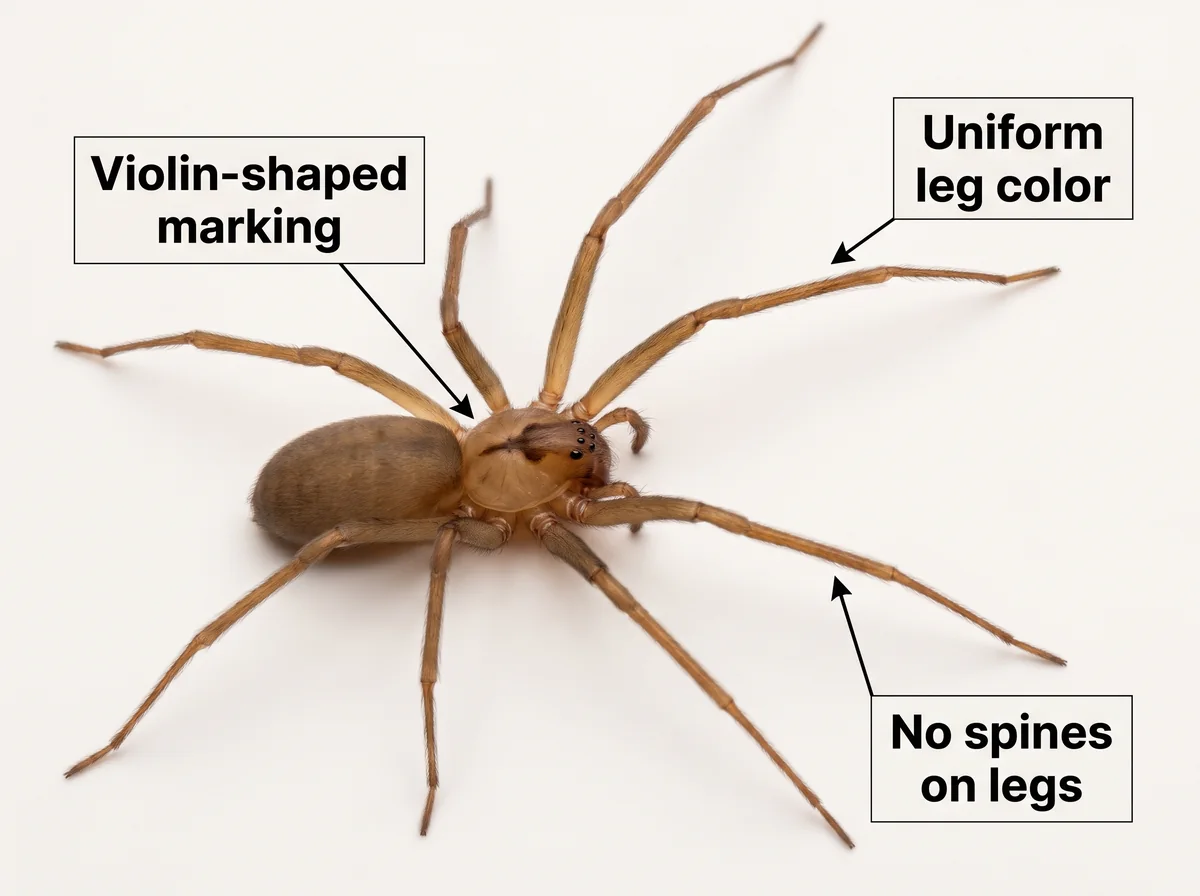
Quick identification facts
Brown Recluse Quick Identification Checklist
Use these five physical checks to evaluate whether a spider you found inside your home could be a brown recluse.
Does a Black Recluse Spider Really Exist?
You might hear people mention a black recluse, but entomologists do not recognize any spider by that common name. The brown recluse (Loxosceles reclusa) is tan to dark brown across its entire body, without black phases or dark color morphs. If you discover a dark black or charcoal spider around your home, you are looking at an entirely different arachnid family rather than a dark variation of a recluse.
Other common species frequently create this confusion when people spot them in dark spaces. Southern house spiders, woodlouse hunters, and certain funnel weavers often share similar indoor hiding spots and display darker coloration. None of these species carry the distinct violin-shaped mark or the unique three-pair eye layout that defines the true brown recluse, making a close visual check straightforward.
When you evaluate a dark specimen, check the cephalothorax and the leg banding. Brown recluse spiders never show dark bands, spots, or mottling on their legs or abdomen. If your spider has distinct black-and-tan striping, thick spiny legs, or eight eyes spread across two rows, you can safely rule out any type of recluse immediately.
- True brown recluse coloration ranges only from light tan to dark brown.
- Dark black spiders found indoors belong to other spider families.
- Recluse legs always have uniform coloration without spots or stripes.
A related clue is covered in What Does a Brown Recluse Look Like?.
Can You Find Brown Recluse Spiders in California?
Many people assume the brown recluse lives along the Pacific coast, but Loxosceles reclusa is not native to California. The established native range extends from southeastern Nebraska across to southwestern Ohio, reaching southward into northwestern Georgia and Texas. Verified occurrences of true brown recluse spiders outside this primary central territory remain exceedingly rare and isolated.
Southern California and other southwestern desert regions do host related native recluse species within the broader Loxosceles genus. While these cousin species share the violin pattern and six-eyed layout, they live primarily in desert environments rather than urban coastal structures. People frequently misidentify harmless local spiders as brown recluses because general spider bite concerns are widespread in western states.
If you live in California or the Pacific Northwest and catch a spider indoors, it is almost certainly a common house spider, cellar spider, or wolf spider. You can check the eyes and leg spines with a magnifying glass to verify what you have found. Without confirmed native populations nearby, finding a true brown recluse in these states is very unlikely.
- The native range is centered in the midwestern and south-central United States.
- Southwestern states have related native desert recluse species, not Loxosceles reclusa.
- True recluse discoveries in far western states are isolated and extremely uncommon.
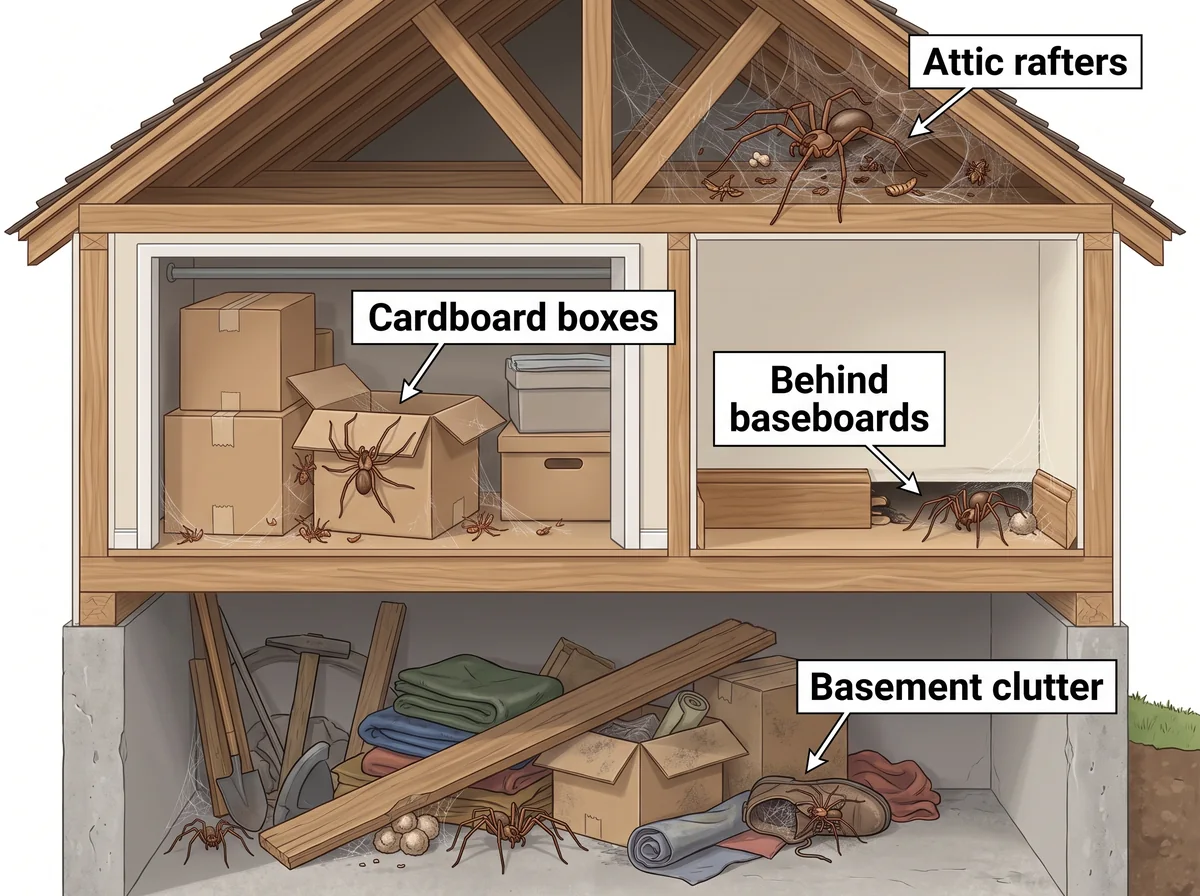
For another part of the identification, open Brown Recluse Habitat and Range: Where Does It Live?.
To compare this detail with another source, Insectio’s brown recluse spider page offers a useful cross-check.
Do Brown Recluse Spiders Carry Babies on Their Backs?
You will never see a mother brown recluse carrying spiderlings on her back. Female brown recluse spiders construct small, flattened egg sacs in secluded corners, closets, or storage boxes. A single female produces one to five egg sacs in her lifetime, with each sac containing roughly 40 to 50 eggs that hatch in about one month.
If you spot a spider carrying dozens of tiny babies clustered over its abdomen, you are observing a wolf spider. Wolf spiders are distinct ground hunters known for carrying their egg sacs attached to their spinnerets and later transporting newly hatched spiderlings on their backs. Brown recluse spiderlings leave the egg sac directly and disperse into nearby crevices on their own.
Brown recluse spiderlings resemble miniature adults in body shape, though they start out with lighter coloration. They molt five to eight times over a period of 10 to 12 months before reaching full adult maturity. You can separate them from wolf spider young by noting their smooth legs, plain abdomen, and absence of maternal transport.
- Brown recluse mothers deposit egg sacs in dark corners and do not carry young.
- Wolf spiders are the common species that carry spiderlings on their backs.
- Young recluse spiderlings hatch after about one month and disperse independently.
How Long Can a Brown Recluse Survive Indoors Without Food?
Brown recluse spiders possess a remarkably slow metabolism that allows them to thrive in harsh, neglected environments. A healthy recluse can survive extended periods of several months without food or water, waiting out long intervals between insect meals. This extreme endurance allows established populations to persist in empty buildings, attics, or stored packing materials for extended seasons.
Adult brown recluse spiders enjoy a relatively long lifespan compared to many other household spiders. Under natural home conditions, extension entomologists report that adults live an average of 2 to 4 years, with some living up to 5 to 10 years in stable, ideal environments. Because they live for multiple years, adults can produce several generations within the same quiet storage zone.
Their ability to withstand starvation makes simple food removal insufficient for total control. If you want to discourage them from living in your home, you need to reduce physical clutter, seal wall voids, and clear out cardboard storage boxes. Combining sticky traps with the elimination of dark hiding spots helps manage numbers even when prey insects are scarce.
- Recluse spiders can live several months without consuming food or water.
- Average adult lifespans span 2 to 4 years in typical indoor settings.
- Removing cardboard boxes and sealing quiet crevices helps reduce long-term harborages.
For another part of the identification, open Is a Brown Recluse Dangerous?.
What Should You Expect If a Brown Recluse Bites You?
A brown recluse bite is usually painless at the moment it happens, meaning you might not notice the initial contact. Within the first hour, a mild localized burning sensation can develop around the site, followed by a small pimple or fluid-filled blister within 6 to 12 hours. Many minor bites resolve on their own without severe tissue damage.
In more severe cases, the surrounding skin can darken and gradually develop into an open, ulcerated sore over 10 to 14 days. A significant bite wound normally requires about 6 to 8 weeks to heal completely and may leave a scar behind. Serious systemic complications, such as hemolytic anemia, remain documented in medical literature but are rare across confirmed bite cases.
There is no widely available commercial antivenom for brown recluse bites in the United States. Medical care is supportive, focusing primarily on cleaning the wound, preventing secondary bacterial infection, and monitoring healing progress. Spider bites in general are frequently over-diagnosed, so saving the spider in a secure jar allows an expert to confirm the species accurately.
- Initial bites are often painless, with burning or a blister developing hours later.
- Ulcerated lesions take 6 to 8 weeks to heal and may produce permanent scarring.
- Medical treatment focuses on routine wound care and preventing bacterial infections.
You can check the same detail against Brown Recluse Size: How Big Is It?.
Related identification guides
What Does a Brown Recluse Look Like?
confirm identity of a specific spider by physical traits
appearanceBrown Recluse Size: How Big Is It?
understand actual dimensions and scale
habitatBrown Recluse Habitat and Range: Where Does It Live?
learn geographic range and native habitat
harmIs a Brown Recluse Dangerous?
gauge overall risk level and separate fact from exaggeration
Frequently asked questions
How do you tell a brown recluse from a wolf spider?
You can distinguish them by eye arrangement, markings, and leg texture. A brown recluse has six eyes arranged in three pairs, uniformly colored legs without spines, and a dark violin mark on its cephalothorax. In contrast, a wolf spider has eight eyes arranged in three rows, thick spiny legs with dark bands, and patterned stripes running down its body.
Where in the house are brown recluse spiders most often found?
Brown recluse spiders favor quiet, dark, undisturbed indoor spaces where they can rest during the day. You will commonly find them tucked inside attics, basements, crawl spaces, closets, and stored cardboard boxes. They are nocturnal hunters that emerge at night to roam along baseboards and floorboards in search of small insect prey.
Is every mysterious skin sore caused by a brown recluse bite?
No, spider bites in general are greatly over-diagnosed relative to other common skin conditions and bacterial infections. Many people attribute unexplained pimples, sores, or red marks to brown recluses even in states where the spider does not live. Unless you saw and safely captured the spider during the bite, medical evaluation is needed to identify the true cause.
Can immature brown recluse spiderlings bite and cause harm?
Immature spiderlings resemble adult brown recluses in general body shape, though they have paler coloring and smaller mouthparts. While growing spiderlings molt five to eight times over 10 to 12 months, their tiny fangs rarely penetrate human skin effectively. Severe envenomation issues are primarily associated with bites from larger, fully matured adult spiders.