Quick identification facts
Recluse vs Wolf Spider Identification Checklist
Work through these physical checks to determine whether your specimen matches a brown recluse or a wolf spider.
How Do You Check the Eyes on Each Spider?
Eye arrangement is the single most reliable diagnostic feature when you compare these two spiders. Most common spiders have eight eyes arranged across their head in two horizontal rows. If your specimen has eight distinct eyes, you can immediately rule out a brown recluse, regardless of its general color or where you found it crawling.
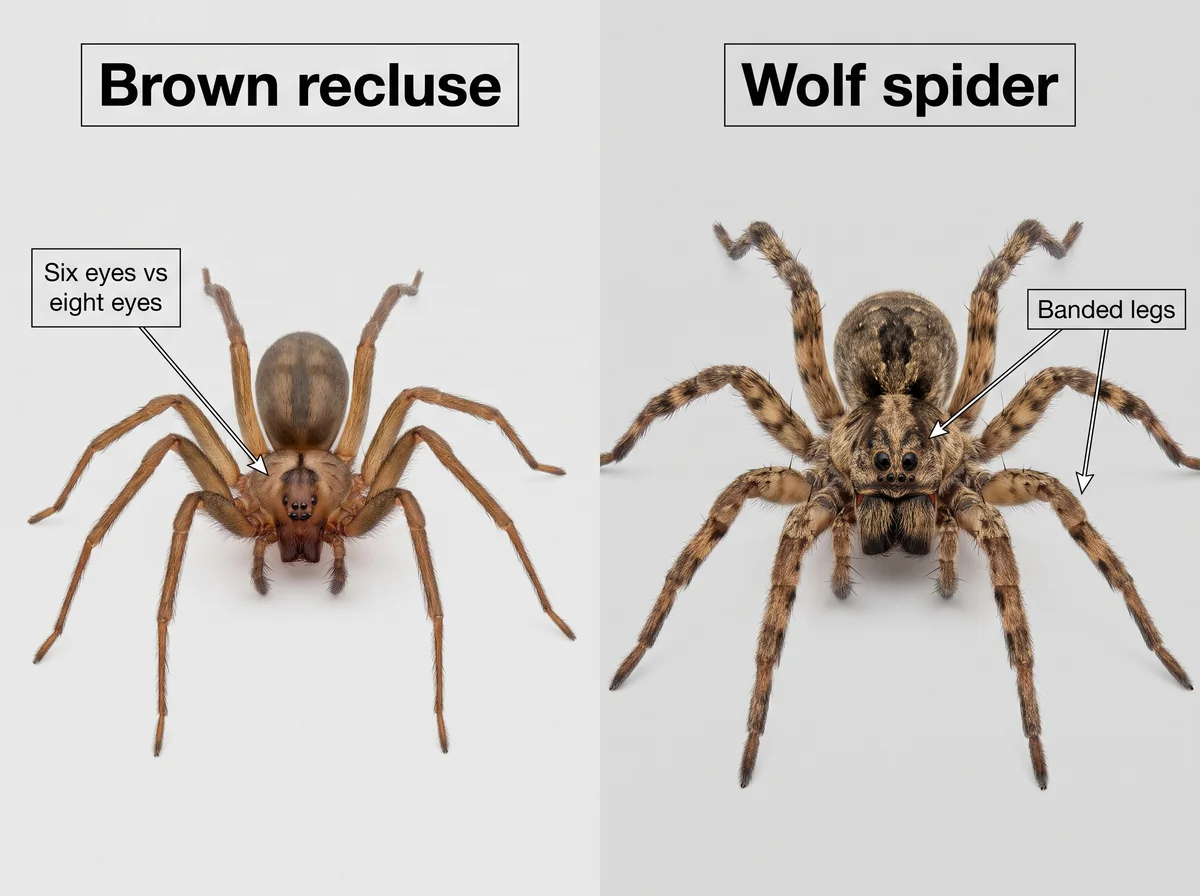
A brown recluse possesses only six eyes grouped into three distinct pairs, known to entomologists as dyads. These pairs form a small semicircle across the front of the cephalothorax, which is the fused head and midsection. You will see one pair positioned right in the center and two lateral pairs placed on the outer sides.
A wolf spider has eight eyes arranged in three distinct tiers to assist its active hunting lifestyle. You can often see this eye difference clearly with a simple magnifying glass or a clear smartphone photo taken with good lighting. Checking the eye pattern gives you a definitive answer even when body markings are faded or difficult to see.
For the next useful comparison, see Brown Recluse vs House Spider: What's the Difference?.
What Do the Leg Markings and Texture Show?
Take a close look at the legs of the spider in front of you. A brown recluse has long, slender legs that show a completely solid, uniform coloration ranging from light tan to dark brown. You will not find any alternating dark and light rings, spots, or striped bands running down the length of its legs.
The texture of the legs also provides an immediate visual clue for your comparison. Brown recluse legs are covered only in soft, fine microscopic hairs, giving them a smooth, delicate look. They completely lack heavy, stout bristles or conspicuous upright spines that stick out along the leg segments.
Wolf spiders, by contrast, frequently display patterned, banded, or mottled legs that blend into rough natural backgrounds. Their legs are noticeably robust, thicker in proportion to their bodies, and covered with prominent, coarse hairs. If you notice distinct bands or heavy spines on the legs, the specimen is not a brown recluse.
This also connects with Brown Recluse Look Alikes: What Could It Be Confused With?.
To compare this detail with another source, BugKnow’s wolf spider vs. brown recluse page offers a useful cross-check.
Does the Spider Have a Clear Violin Marking?
The top of the cephalothorax often reveals another helpful clue for your identification. A brown recluse usually features a dark, contrasting violin-shaped or fiddle-shaped mark directly behind its eyes. The broader base of this violin shape sits near the eye cluster, while the narrow neck points backward toward the spider's abdomen.
Contrast on this violin marking can vary significantly from one individual spider to another. Younger spiders or freshly molted individuals may display a very faint mark that is difficult to distinguish against the tan background. Because this pattern can be subtle or obscured, entomologists always treat eye arrangement as the primary diagnostic mark.
Wolf spiders often display longitudinal stripes or broad pale bands running along their upper bodies, but they lack this crisp, dark violin shape. If your spider has multiple light stripes running down the center of its back or lacks the smooth violin outline entirely, it is much more likely to be a wolf spider or another harmless look-alike.
How Does Body Texture and Abdomen Color Compare?
Examining the spider's abdomen gives you another reliable visual filter. A brown recluse has an abdomen that is completely uniform in color, matching its general tan, grayish-brown, or dark brown body tone. You will never see spots, chevrons, geometric patches, or contrasting stripes across a recluse's rear body section.
The surface texture of the brown recluse is soft and evenly covered with delicate, fine hairs. It never looks shaggy, fuzzy, or heavily armored when you inspect it under direct light. Immature recluse spiders share this exact same body shape and uniform coloration, though their overall color tone is often slightly lighter than mature adults.
Wolf spiders typically present an intricate, mottled abdomen filled with earth-toned camouflage patterns. Their bodies are dense, thickset, and visibly furry, which gives them a heavier, more robust silhouette. A spider with a patterned, multi-colored, or distinctly hairy abdomen does not fit the physical profile of a brown recluse.
You can check the same detail against What Does a Brown Recluse Look Like?.
How Big Are These Two Spiders When Fully Grown?
Size alone can help you narrow down your specimen, though it should always be combined with physical field marks. An adult brown recluse is a medium-sized spider, measuring about the size of a U.S. quarter when its legs are fully extended outward. Female recluse bodies measure 10 to 15 millimeters, with males measuring roughly half that body size.
Immature brown recluse spiders are naturally smaller than adults, but they maintain the same leg proportions and uniform body color. Because small spiders can easily be misidentified, using a coin or ruler for scale in your photograph can help you assess whether the dimensions match known recluse growth stages.
Wolf spiders encompass a wide range of species, and many common varieties grow significantly larger and heavier than any adult recluse. A large, bulky spider with thick legs that spans several inches across is almost certainly a wolf spider rather than a brown recluse, which always remains relatively slender and compact.
A related clue is covered in Brown Recluse Habitat and Range: Where Does It Live?.
Related identification guides
What Does a Brown Recluse Look Like?
confirm identity of a specific spider by physical traits
comparisonBrown Recluse vs House Spider: What's the Difference?
distinguish brown recluse from common indoor house spiders
comparisonBrown Recluse Look Alikes: What Could It Be Confused With?
broadly identify which other spiders get confused with a brown recluse
habitatBrown Recluse Habitat and Range: Where Does It Live?
learn geographic range and native habitat
Frequently asked questions
Can I tell a brown recluse from a wolf spider without looking at the eyes?
Yes, you can often separate them by looking at leg markings and body hair. A brown recluse has smooth, uniformly colored legs with no dark bands, spots, or heavy spines. Its abdomen is a solid tan or brown without patterns. A wolf spider typically shows mottled colors, banded legs, and coarse, visible hair across its thick body.
Do wolf spiders have a violin shape on their backs?
No, wolf spiders do not have the distinct dark violin mark found on a brown recluse. Wolf spiders often have pale or dark stripes running lengthwise down their bodies, which people sometimes mistake for a violin pattern. A true recluse mark has a wide base near the eyes and a distinct neck pointing toward the abdomen.
Are brown recluse spiders noticeably hairy like wolf spiders?
No, brown recluse spiders are not visibly hairy. While they possess microscopic, fine hairs across their legs and body, their overall appearance is smooth and delicate. Wolf spiders, in contrast, have prominent, coarse hair that gives them a distinctly furry or shaggy look even when viewed from several feet away.
What should I do if I find a spider that matches these recluse traits?
If you observe six eyes in three pairs, uniform legs, and a violin mark, avoid handling the spider directly. You can safely trap it under a clear glass jar and slide a stiff piece of paper beneath it. Keeping the specimen intact allows a professional entomologist or extension agent to verify the physical field marks.