Quick identification facts
Infestation Indicator Checklist
Use this checklist to evaluate whether the physical evidence in your home suggests an active brown recluse population.
What Do Shed Skins Tell You About an Infestation?
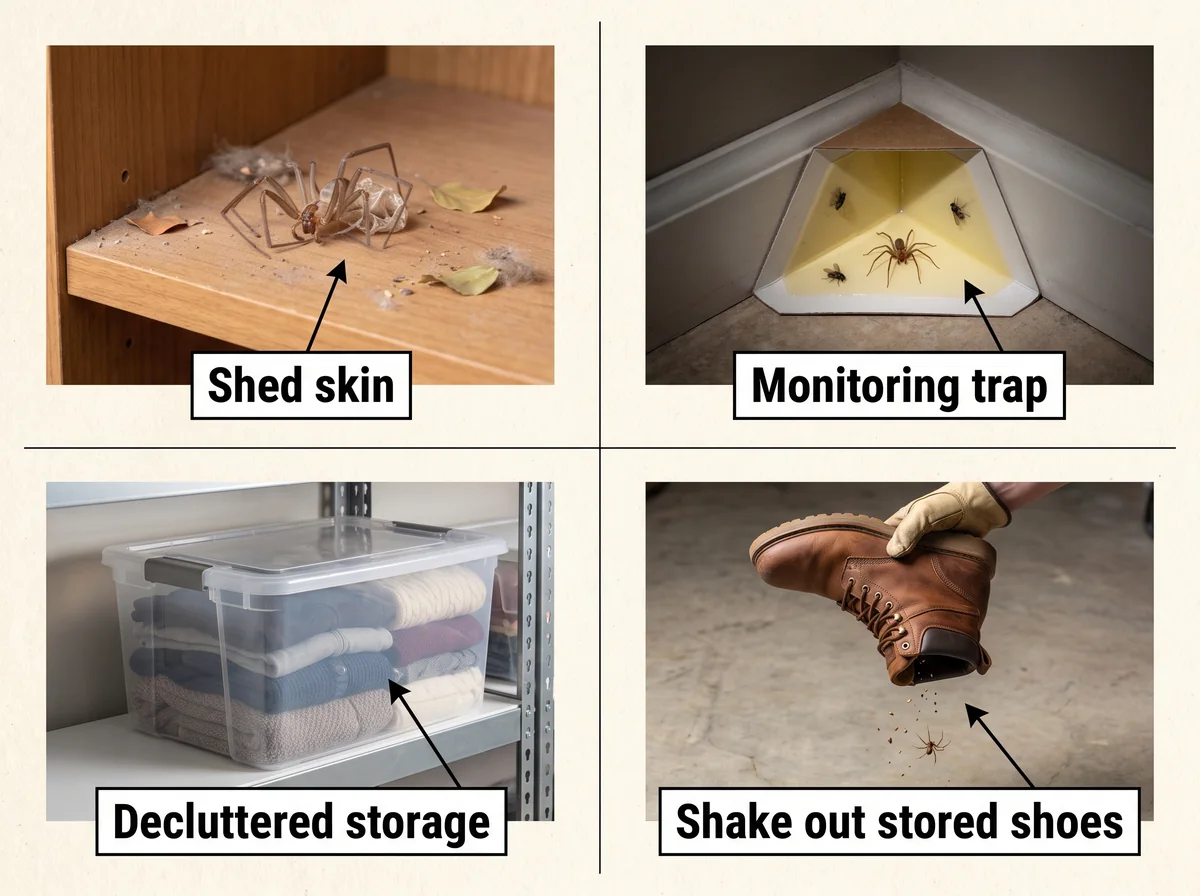
Finding shed skins, known as exuviae, is one of the clearest signs that brown recluse spiders live in your home. As these spiders grow, they cast off their hard outer coverings and leave them behind in quiet, dark spots. You will often discover these light brown husks tucked inside cardboard boxes, behind stored furniture, or along baseboards.
Because shed skins keep their original shape well, you can inspect them just like live specimens to help confirm the species. You can examine the head area of a cast skin under good light to look for the distinct six-eye pattern. This lets you check for your target safely without getting close to a live, defensive spider.
A single shed skin might simply come from a wandering spider that molted weeks ago. However, finding several skins of different sizes points to an established population. When you see multiple cast skins across your attic, basement, or closets, it shows spiders are actively feeding and growing indoors across several stages of life.
- Look for cast skins inside storage boxes, closets, and along foundation walls.
- Inspect the head region of the cast skin for the distinct three-pair eye layout.
- Multiple skin sizes indicate active, ongoing reproduction and development.
This also connects with Brown Recluse in Your House: Why Is It There?.
What Do Brown Recluse Webs Look Like?
Brown recluse webs do not look like the tidy, circular webs built by typical garden spiders. Instead, you will see messy, irregular tangles of silk that look loose and thin. These spiders do not use their silk to snare flying insects in open rooms, so their webs serve mainly as quiet shelters and daytime resting spots.
You will usually find these loose webs built close to the floor or pressed flat against vertical walls in secluded corners. Look for them along baseboards, behind stacked boxes, under low furniture, or inside dark crawl spaces. Because the silk strands are off-white and loosely spun, you might easily overlook them during quick cleaning.
If you spot neat, symmetrical webs hanging high in window frames or across open ceilings, you are looking at a different spider species. Brown recluse webs remain hidden near floor edges and wall corners where the spider can tuck away safely. Finding several of these messy silk shelters is another clear sign of ongoing activity.
- Webs appear tangled, sparse, and irregular rather than neatly patterned.
- Silk structures are located low to the ground or flat against walls.
- Webs serve as secluded hiding retreats rather than airborne prey snares.
To compare this detail with another source, Insectio’s signs of brown recluse infestation page offers a useful cross-check.
Where Should You Check for Hiding Spiders?
Brown recluse spiders seek out dark, dry, quiet places where foot traffic is low. You should focus your search on attics, unfinished basements, crawl spaces, and rarely used closets. Stacks of cardboard boxes provide ideal shelter because the narrow gaps between folds mimic natural rock piles and loose tree bark.
Inside living spaces, these spiders hide behind wall hangings, inside shoes left on closet floors, and within folds of stored blankets. You may also find them resting under furniture skirts, inside cluttered dresser drawers, or behind access panels. Their ability to squeeze into narrow gaps allows them to live inside hollow walls without being seen.
When you inspect these hiding zones, move stored bins carefully and check items before picking them up. You should make deliberate noise or create vibrations before reaching into dark areas to encourage spiders to run away instead of biting. Keeping your storage off the floor makes checking these vulnerable zones much easier.
- Inspect attics, basements, and dark closets with stacked storage.
- Check behind baseboards, wall voids, and underneath low furniture.
- Vibrate or tap storage bins before reaching into dark interior spaces.
This also connects with Brown Recluse Bite Prevention: How Can You Avoid It?.
How Can You Confirm You Have a Brown Recluse?
Visual confirmation requires looking past general body shape and checking specific physical marks. Adult brown recluse spiders have bodies measuring between one-quarter and one-half inch long, with an overall leg span similar to a U.S. quarter. Their long legs and oval abdomens are uniformly tan to dark brown without any stripes, bands, or spots.
Most spiders have a dark violin marking on top of the head area, with the narrow neck pointing back toward the abdomen. However, this marking can vary in contrast and may look faint on younger spiders. Because look-alikes like wolf spiders or woodlouse hunters also have brownish bodies, the violin mark alone is not always enough.
To reach positive identification, you must examine the eye pattern using a magnifying lens or a clear close-up photograph. A true brown recluse has exactly six eyes arranged in three pairs, called dyads, in a semicircle across the head. Most common house spiders have eight eyes in two rows, making eye count your most reliable clue.
- Observe the uniform tan to dark brown body and unbanded, slender legs.
- Check for a dark violin marking on the head with the neck pointing backward.
- Verify six eyes arranged in three distinct pairs using good magnification.
Why Is Professional Pest Control Recommended?
Eliminating a brown recluse population is hard to accomplish with basic store sprays. Because these spiders stay hidden deep inside hollow walls, attic insulation, and tight storage crevices, surface sprays rarely reach them. Their long legs also keep their bodies raised off treated floors, which reduces their contact with household products.
Pest management specialists use targeted methods designed for secretive spiders, placing monitoring traps and treating hollow wall spaces safely. A trained professional can evaluate your home, locate hidden spider clusters, and place materials directly where pests travel. Their tools help ensure treatments reach quiet nesting spots that standard sprays miss.
Attempting to clear heavy infestations on your own can also increase your risk of accidental contact. Moving crowded boxes or sorting through deep clutter without safe habits can scatter defensive spiders into main living areas. Relying on professional help provides a thorough plan while you focus on basic housekeeping and clutter removal.
- Hidden populations inside wall voids avoid surface-level retail sprays.
- Pest professionals use targeted placement strategies for secluded harborages.
- DIY clearing can inadvertently scatter defensive spiders into main living areas.
What Daily Habits Help Protect Your Household?
While you deal with a spider problem, simple daily habits will reduce your chances of accidental contact. You should always shake out stored clothes, shoes, work gloves, and spare blankets before using them. Brown recluses like to hide inside fabric folds, and bites usually happen when a spider gets trapped against bare skin.
Reducing clutter throughout your home removes the sheltered hiding spots that allow these spiders to thrive indoors. Swap out cardboard storage boxes for smooth, sealed plastic bins to keep pests out of your belongings. Keeping clothes and bedding off closet floors eliminates convenient daytime hiding places near your bed.
You can also create a safer bedroom by pulling your bed slightly away from the wall and removing floor-length bed skirts. When you work in basements or attics, wear heavy work gloves and tap storage boxes before picking them up. These simple precautions keep your family safe while you work to eliminate the population.
- Shake out all clothing, footwear, and bedding before daily use.
- Replace cardboard boxes with tight-sealing plastic storage containers.
- Move beds away from walls and remove dust ruffles to eliminate climbing paths.
This also connects with Brown Recluse Web Identification: What Does It Look Like?.
Related identification guides
Brown Recluse in Your House: Why Is It There?
practical indoor inspection to confirm or rule out presence
preventionBrown Recluse Bite Prevention: How Can You Avoid It?
learn behavioral precautions to reduce bite risk
signsBrown Recluse Web Identification: What Does It Look Like?
identify a spider by its web structure
faqBrown Recluse FAQ: What Do People Ask Most?
get short direct answers to miscellaneous one-off questions
Frequently asked questions
What is the most definitive physical sign of a brown recluse infestation?
The most definitive sign is finding multiple shed skins alongside uniformly tan spiders in quiet storage areas. To confirm the species positively, you must inspect the head region under good magnification to verify the six eyes arranged in three pairs. While a violin mark on the cephalothorax is common, this unique three-pair eye layout is the standard mark entomologists use to confirm an active infestation.
How do brown recluse webs differ from typical spider webs?
Brown recluse webs are messy, irregular, and off-white, lacking any neat circular design. You will find them built close to the floor or tucked flat against walls in secluded spots like closets, basements, and behind furniture. They do not spin webs out in open spaces to catch flying prey; instead, their tangled silk functions purely as a quiet resting retreat during daylight hours.
Why is finding shed skins helpful for diagnosing spider presence?
Shed skins allow you to confirm a brown recluse population without handling live specimens. These cast-off coverings retain physical details, including the three-pair eye layout and plain, unbanded legs. Finding multiple skins of different sizes across storage areas confirms that spiders are actively molting, feeding, and maintaining an established, reproducing population inside your home rather than wandering in as lone visitors.
What precautions should you take when entering suspected spider areas?
When inspecting attics, basements, or closets, make noise and create vibrations beforehand so hiding spiders run away. Always wear work gloves when handling stored items, and shake out shoes, clothing, and blankets before putting them on. Storing belongings in sealed plastic containers instead of cardboard boxes also removes common hiding spots and keeps spiders away from your personal items.