Quick identification facts
Baby Brown Recluse Field Checklist
Use this checklist with a magnifying glass or macro photo to evaluate whether a tiny brown spider exhibits juvenile brown recluse characteristics.
How Does a Spiderling Differ From an Adult?
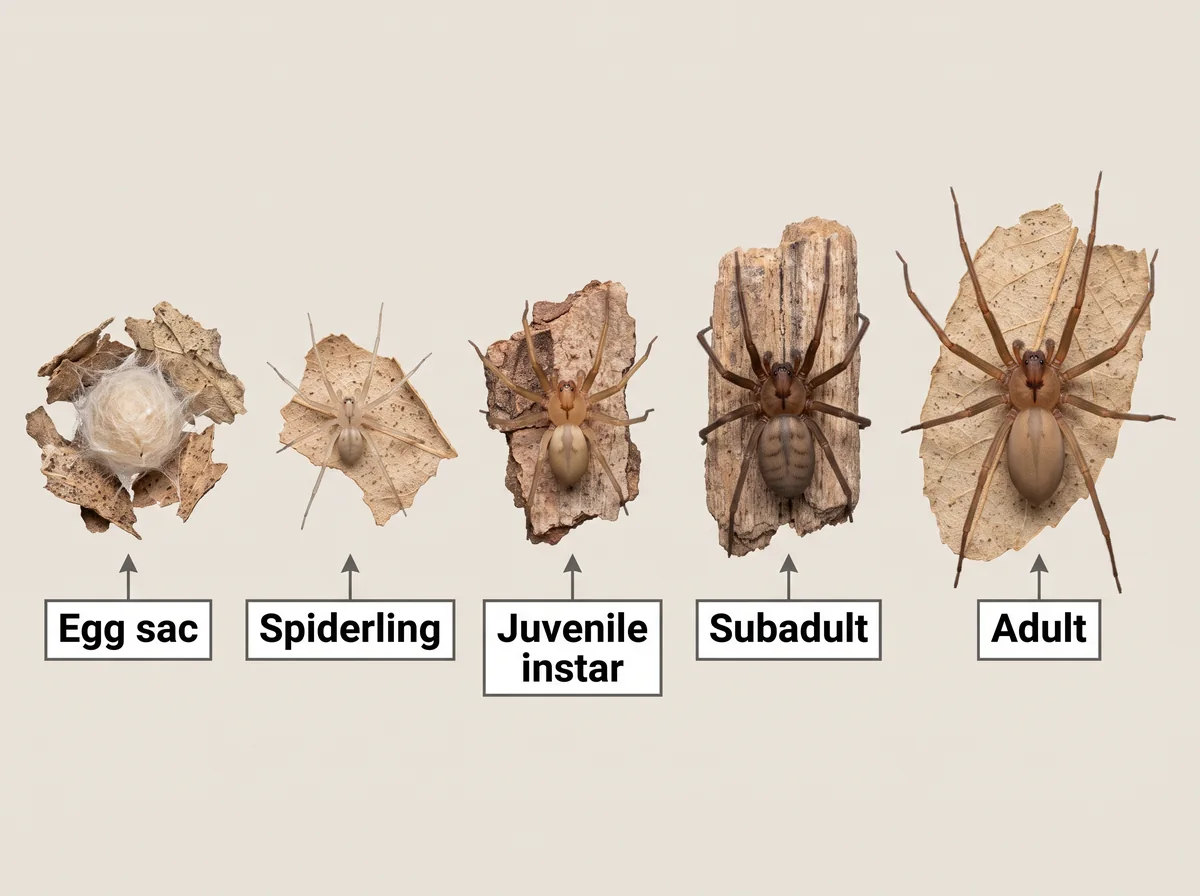
When you look at a baby brown recluse, the primary difference you will notice is its overall size and color intensity. Immature spiders share the same body proportions and long, slender legs as mature specimens, but their coloration is much lighter. Freshly emerged spiderlings appear pale tan or almost translucent, lacking the deeper brown hues found on mature spiders.
The distinctive dark violin marking on the cephalothorax is often barely visible or completely missing on very young spiderlings. Because this contrast builds gradually across growth stages, you cannot rely solely on the fiddle pattern when checking a tiny specimen. Instead, observing the overall uniform shading across the body provides an immediate field clue.
You will also find that spiderlings lack any decorative markings on their abdomen or legs. Their legs are long, thin, and covered in fine hairs rather than heavy, conspicuous spines. If you find a tiny spider with distinct stripes, spots, or mottling on its abdomen, you can rule out a juvenile brown recluse immediately.
- Body color is pale tan to light cream rather than deep brown
- Violin marking on the head area is often faint or not yet visible
- Abdomen and legs remain completely uniform with no stripes or spots
For another part of the identification, open Brown Recluse Egg Sac: What Does It Look Like?.
How Can You Confirm the Eyes on a Tiny Spider?
Because the violin marking varies and remains faint in younger spiders, the eye arrangement serves as the most dependable diagnostic feature. Most common household spiders possess eight eyes arranged across two horizontal rows. In contrast, a brown recluse at any stage has only six eyes arranged in three distinct pairs, known as dyads, forming a semicircle.
To inspect these eyes on a tiny spiderling, you will need good lighting and a magnifying glass or a clear macro photograph. One pair sits in the center front, while the other two pairs sit on the left and right sides. This dyad configuration is present as soon as the young spider emerges and remains consistent through every life stage.
When you zoom in on a photograph of the head, check the spacing between the three pairs. A wide gap separates the center pair from each lateral pair. If your close-up image reveals eight distinct eyes or pairs touching in straight rows, you are looking at a harmless look-alike rather than a young brown recluse.
- Six total eyes arranged in three separate pairs (dyads)
- One dyad sits centrally with two lateral dyads forming a curved arc
- Remains the primary identifier when the violin marking is faint
This also connects with Brown Recluse Life Cycle: How Does It Develop?.
If you want a second reference, Insectio’s brown recluse appearance page covers the same topic from another angle.
How Fast Do Young Recluses Grow and Molt?
A brown recluse spiderling undergoes a lengthy developmental process before reaching its full mature size. After spending roughly a month developing inside an off-white silken egg sac, the spiderlings emerge and begin their independent growth cycle. They do not transform through metamorphosis, but instead enlarge by shedding their rigid outer exoskeletons.
As a spiderling grows, it will molt between five and eight times over a period of roughly 10 to 12 months. With each molt, the spider darkens slightly in color, moving from pale cream to darker tan and eventually the typical adult range of tan to dark brown. The violin pattern also becomes progressively darker and more defined.
You may find these shed skins, known as exuviae, left behind in quiet storage areas, closets, or small gaps around the home. Finding multiple tiny shed skins is a clear sign of growing spiderlings nearby. These durable cast skins retain the distinct six-eye arrangement, allowing you to identify the species without capturing a live specimen.
- Spiderlings emerge from silken egg sacs after about 24 to 36 days
- Development requires 5 to 8 molts over 10 to 12 months to reach maturity
- Shed skins retain diagnostic eye patterns and indicate local growth
For the next useful comparison, see What Does a Brown Recluse Look Like?.
Can a Baby Brown Recluse Bite You?
A common concern is whether newly emerged spiderlings possess enough venom or physical strength to pierce human skin. While young brown recluses produce venom early in their development, their tiny mouthparts make successful defensive bites against humans extremely unlikely in their earliest stages. As they complete several molts and approach adult size, their ability to pierce skin increases.
A brown recluse bite is typically painless at first, which means you might not realize contact occurred until symptoms develop later. Within the first hour, a localized burning sensation can appear, often followed by a small pimple or fluid-filled blister within 6 to 12 hours. In more severe cases, the tissue around the puncture can darken and form an open, ulcerated sore over 10 to 14 days.
Not every brown recluse bite results in severe tissue destruction or ulceration, and serious illness or death is rare. Because spider bites are frequently over-diagnosed compared to other skin lesions, you should preserve any spider you suspect caused a bite. There is no widely available antivenom in the United States, so medical treatment focuses on supportive wound care and preventing secondary infection.
- Early spiderlings have tiny mouthparts that rarely penetrate human skin
- Bites initially feel painless but can develop a burning blister within hours
- Treatment is supportive, focusing on careful wound hygiene and infection control
A related clue is covered in Brown Recluse Bite Symptoms and Stages: What Should You Watch For?.
Which Common Look-Alikes Might You Find Instead?
Many tiny brown spiders found indoors are mistaken for recluse spiderlings due to their small size and rapid movement. The southern house spider is one of the most frequent look-alikes, as its juveniles share similar tan coloring and leg lengths. However, house spiders have eight closely grouped eyes and lack the specific dyad arrangement of a true recluse.
Juvenile wolf spiders are another frequent source of confusion when you inspect baseboards or storage boxes. Wolf spiders display distinct dark stripes along their head and mottled, patterned abdomens, contrasting sharply with the plain, uniform body of a brown recluse. Wolf spiders also possess prominent spines along their legs, whereas recluse legs bear only fine, soft hairs.
You might also encounter young woodlouse hunter spiders in damp crawl spaces or under ground-level debris. While woodlouse hunters also have six eyes, their eyes form a tight, compact cluster rather than three separated dyads, and their bodies feature reddish-brown heads with pale grayish-white abdomens. Comparing these visible markers lets you quickly separate harmless species from a brown recluse.
- Southern house spiders have eight clustered eyes rather than three dyads
- Wolf spider young feature striped backs, mottled abdomens, and spiny legs
- Woodlouse hunters possess a tightly grouped eye cluster and reddish head
For the next useful comparison, see Is a Brown Recluse Dangerous?.
Related identification guides
What Does a Brown Recluse Look Like?
confirm identity of a specific spider by physical traits
life cycleBrown Recluse Life Cycle: How Does It Develop?
understand developmental stages and timing
eggsBrown Recluse Egg Sac: What Does It Look Like?
identify a found egg sac
harmBrown Recluse Bite Symptoms and Stages: What Should You Watch For?
identify and track the visual progression of a suspected bite
Frequently asked questions
What does a newly hatched baby brown recluse look like?
A newly hatched baby brown recluse is tiny, pale tan or off-white, and shares the adult body shape with long, thin legs. Its violin marking is typically faint or completely absent. You can confirm its identity by using magnification to check for six eyes arranged in three distinct pairs in a semicircle. The abdomen and legs will always be uniformly colored without any spots, bands, or dark mottling.
How long does it take for a spiderling to become an adult?
A brown recluse spiderling takes roughly 10 to 12 months to reach full adulthood. During this development window, the young spider molts five to eight times, gradually increasing in size and darkening in color. Once mature, adults typically live an average of 2 to 4 years, with some surviving even longer under ideal conditions. They can also survive for several months without regular access to food or water.
Are baby brown recluse spiders dangerous to humans?
Very young spiderlings are rarely dangerous because their small mouthparts struggle to pierce human skin. However, as they grow through successive molts, their biting capacity increases. A recluse bite is usually painless initially but can progress to a burning blister within 6 to 12 hours. While severe ulcerating wounds taking 6 to 8 weeks to heal can occur, serious systemic complications are rare, and many bites remain mild.
How can you tell a recluse spiderling from a young wolf spider?
You can distinguish them by inspecting their patterns and leg textures. A juvenile brown recluse has a completely uniform abdomen, long thin legs with only fine hairs, and six eyes arranged in three pairs. In contrast, a young wolf spider features conspicuous dark stripes across its cephalothorax, a mottled pattern on its abdomen, heavy spines along its legs, and an eight-eye configuration arranged across three distinct rows.