Quick identification facts
Look-Alike Rapid Screener
Use these visual checks to determine if the specimen you found matches a brown recluse or a harmless look-alike.
Why Do So Many Spiders Get Mistaken for a Brown Recluse?
You might spot a brownish spider moving across the floor and immediately worry about its identity. General brown coloration is extremely common across many spider families, which causes widespread confusion. People often assume any medium-sized, plain brown spider inside a building belongs to this one specific group, leading to frequent false alarms.
A closer inspection usually reveals markings or body shapes that rule out a recluse right away. Many common look-alikes carry distinctive chevron patterns, spotted abdomens, or thick, spiny legs that a genuine brown recluse never has. Learning the exact combination of baseline physical traits helps you evaluate what you see without jumping to conclusions.
Your most reliable starting point is observing the overall color pattern. A true brown recluse has an abdomen and legs that are completely uniform in color, ranging from light tan to dark brown. If your specimen shows multi-toned patches, bands across the joints, or mottled spots, you are looking at a different species entirely.
A related clue is covered in Brown Recluse vs Wolf Spider: What's the Difference?.
How Can You Use Eye Count to Rule Out Common Look-Alikes?
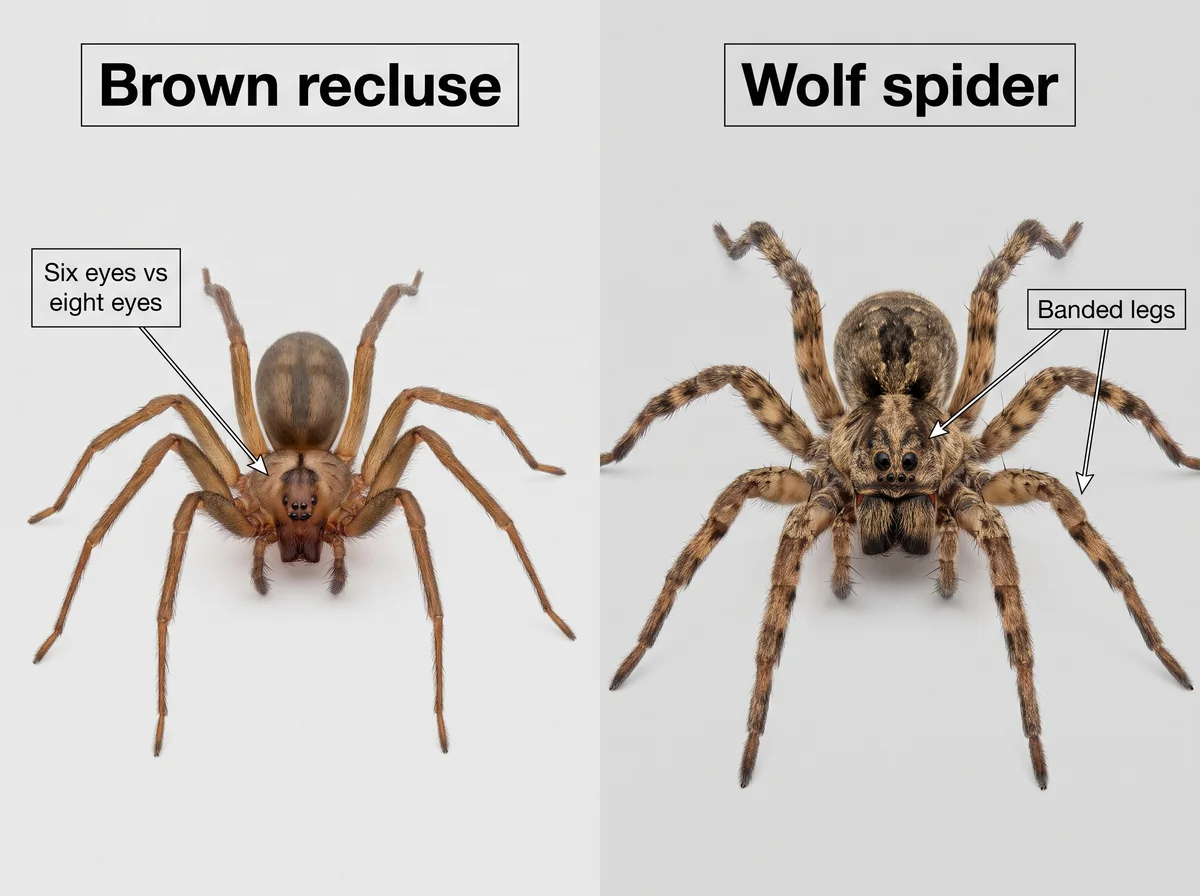
The fastest, most definitive way to separate a brown recluse from nearly all look-alikes is to examine the eyes. Most common spiders, including wolf spiders and funnel weavers, have eight eyes arranged in two distinct rows across the front of the head. In sharp contrast, a brown recluse has only six eyes.
These six eyes are organized into three pairs, known as dyads, forming a neat semicircle around the front of the cephalothorax. You will see one central pair sitting in front and two lateral pairs positioned slightly farther back on each side. A small magnifying glass or a clear digital close-up photograph allows you to see this pattern clearly.
Because eight eyes are standard for the vast majority of spiders you will encounter indoors, checking for dyads lets you eliminate almost every look-alike in seconds. If you count eight eyes on your specimen, you can immediately rule out a brown recluse regardless of how brown or violin-like its markings appear.
You can check the same detail against Brown Recluse vs House Spider: What's the Difference?.
To compare this detail with another source, Insectio’s brown recluse spider page offers a useful cross-check.
What Separates a Wolf Spider from a Brown Recluse?
Wolf spiders are among the most frequent species confused with the brown recluse because of their brown shades and ground-hunting habits. However, you can distinguish them by their patterns and body textures. Wolf spiders typically have bold stripes running down their bodies and mottled, patterned abdomens, whereas a brown recluse is solid and plain.
The legs of these two spiders also look completely different upon close view. A wolf spider possesses stout, robust legs equipped with prominent, raised spines used for grasping prey. A brown recluse has slender, delicate legs covered only in fine hairs, entirely lacking noticeable, rigid spines along the segments.
Eye arrangement provides another obvious distinction if you look at the face. Wolf spiders feature eight eyes arranged in three rows, dominated by two very large, forward-facing eyes in the middle row. A brown recluse lacks these enlarged forward lenses, displaying only the three evenly sized pairs in a curved arc.
How Do Woodlouse Hunters and Funnel Weavers Differ?
Woodlouse hunter spiders share a six-eyed trait and a generally plain body, which makes them another common source of mistaken identity. You can easily tell them apart by looking at their distinctive coloration and mouthparts. Woodlouse hunters feature a reddish-orange cephalothorax, very large forward-projecting jaws, and a pale, grayish-tan abdomen with no violin mark.
Funnel weavers are frequently found around home foundations and corners, where their drab tan tones cause people to mistake them for recluses. Unlike the smooth-bodied recluse, funnel weavers display dark, distinct stripes along their head region and patterned markings on their abdomens. They also have eight eyes and noticeable spines on their legs.
When comparing any of these species to a brown recluse, remember to look for the characteristic dark violin or fiddle pattern on the cephalothorax. On a recluse, the wide base of the violin sits near the head and the narrow neck points back toward the abdomen, a specific marking that neither woodlouse hunters nor funnel weavers possess.
For another part of the identification, open What Does a Brown Recluse Look Like?.
What Clues Does the Southern House Spider Provide?
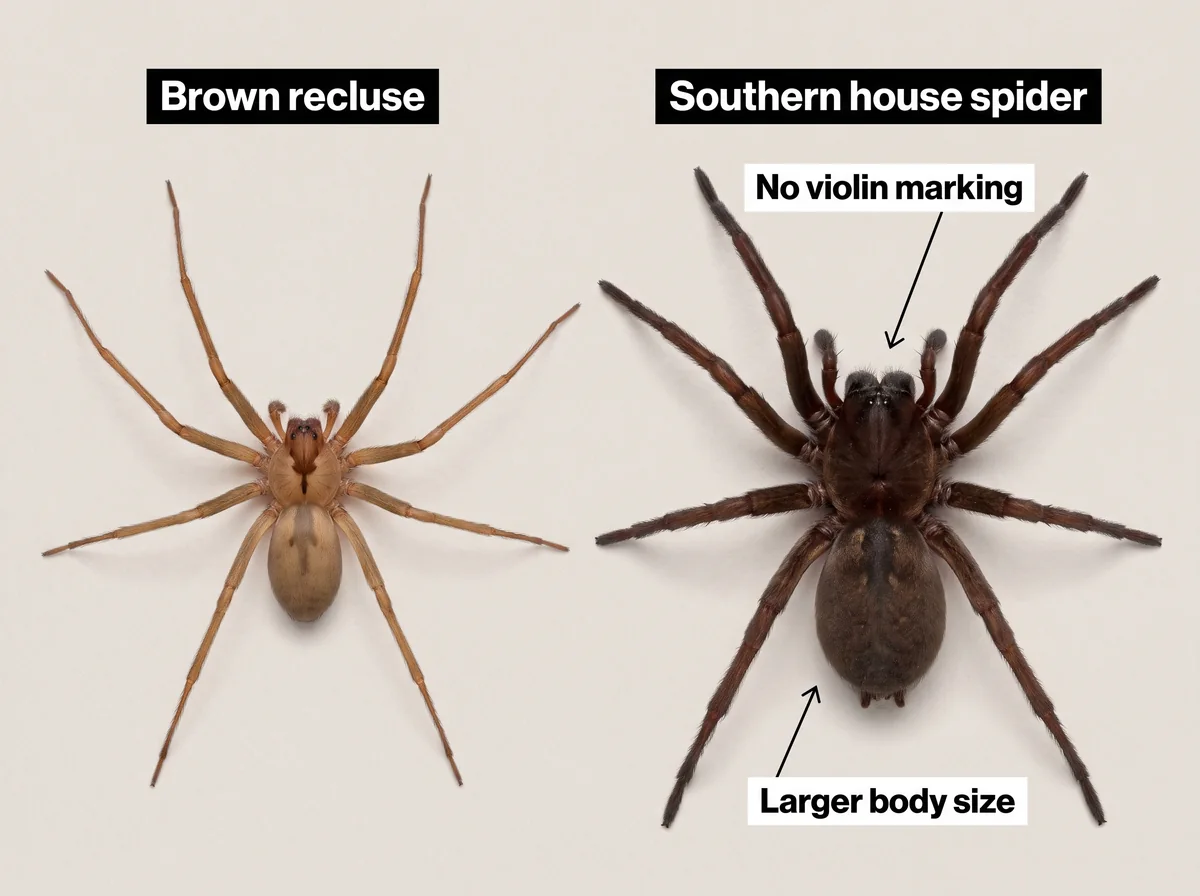
Male southern house spiders are frequently mistaken for brown recluses because they share a similar light brown color and long, slender legs. When one wanders indoors in search of a mate, its general posture mimics a recluse closely. However, examining the head area and overall body texture reveals clear differences that settle the comparison.
The southern house spider has eight eyes tightly clustered together on a small raised bump at the front of its head, rather than six eyes spread in three pairs. In addition, its mouthparts feature elongated pedipalps that extend noticeably forward like an extra set of short antennae, which a brown recluse does not have.
A southern house spider also lacks the sharply defined violin marking seen on a recluse. While it may have slight shading on the cephalothorax, it does not form the distinct dark fiddle shape pointing toward the waist. Checking for the three separate eye pairs remains your simplest method to confirm the difference.
You can check the same detail against Brown Recluse Habitat and Range: Where Does It Live?.
Related identification guides
What Does a Brown Recluse Look Like?
confirm identity of a specific spider by physical traits
comparisonBrown Recluse vs Wolf Spider: What's the Difference?
distinguish two specific commonly confused spiders
comparisonBrown Recluse vs House Spider: What's the Difference?
distinguish brown recluse from common indoor house spiders
habitatBrown Recluse Habitat and Range: Where Does It Live?
learn geographic range and native habitat
Frequently asked questions
Can a brown recluse have stripes on its legs?
No. A brown recluse has solid, uniformly colored legs ranging from light tan to dark brown. Its legs are covered in very fine hairs and do not feature dark bands, rings, or stripes across the segments. If you observe distinct banding or striping on the legs of your spider, you are looking at a common look-alike such as a wolf spider or a funnel weaver rather than a brown recluse.
Why is the violin marking not always enough to identify a brown recluse?
The contrast of the violin marking can vary significantly depending on the age of the spider. Immature brown recluse spiders often have much lighter coloration, making the dark violin shape faint or difficult to see clearly. Because other brown spiders can also feature dark smudges or patterns on their cephalothorax, entomologists rely on the three-pair eye arrangement as the most definitive physical diagnostic mark to confirm or rule out the species.
Do brown recluse look-alikes pose the same risks?
Most spiders commonly mistaken for the brown recluse, such as wolf spiders, funnel weavers, and southern house spiders, are essentially harmless to humans. While any spider can bite if trapped or pressed against the skin, their venom does not cause the severe necrotic tissue damage associated with recluse bites. University extension resources consistently note that spider bites in general are greatly over-diagnosed compared to their actual real-world occurrence.
How can I safely examine the eyes of a spider?
You can safely inspect the eye pattern by capturing the spider under a clear glass jar or plastic container against a flat, solid surface. Once the spider is contained, use a magnifying glass or zoom in using a smartphone camera under good lighting to count the lenses. Look specifically at the front of the head to check whether the spider has eight eyes or six eyes organized into three distinct pairs.