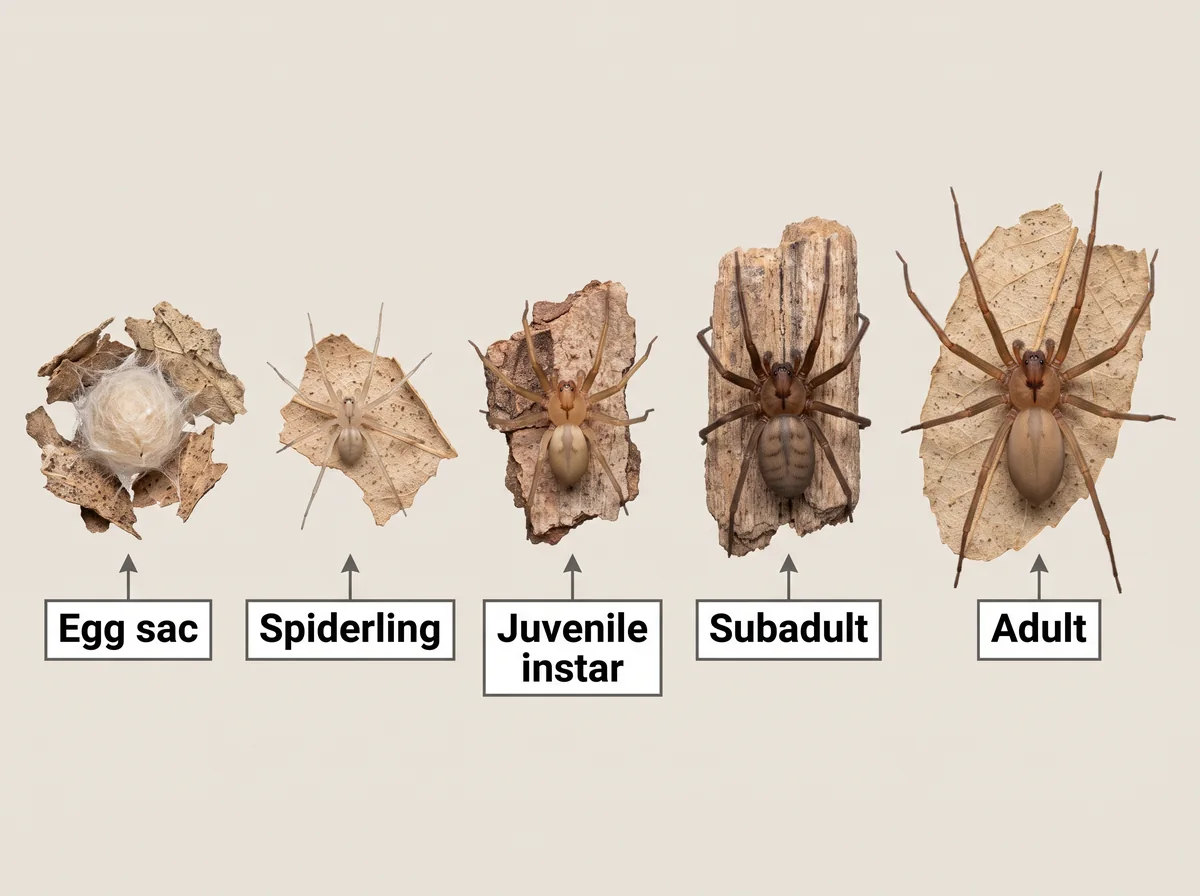
Quick identification facts
Life Cycle Stage Identifier
Use these physical observations to determine which life cycle stage a discovered spider or evidence represents.
When Do Females Produce Egg Sacs?
You will notice that brown recluse reproductive activity follows a clear seasonal pattern tied directly to warmer temperatures. Egg-laying takes place primarily from May through July or August, when warm conditions support rapid embryonic growth. Female spiders construct flat, off-white silken cases in quiet, sheltered locations to protect their developing broods from external disturbances.
Over the course of her lifetime, a single female brown recluse typically produces between one and five egg sacs. Each individual sac contains roughly 40 to 50 eggs, though smaller clutches of 20 to 50 eggs can also occur. The female often remains close to her egg sac, guarding the clutch until the young emerge.
Because egg deposition occurs across several summer months, new spiderlings do not all emerge at the exact same time. If you inspect an indoor space during the summer, you might find active egg sacs alongside mature adults. This staggered egg-laying helps ensure that unexpected environmental changes do not wipe out an entire generation at once.
For the next useful comparison, see Brown Recluse Egg Sac: What Does It Look Like?.
How Long Does It Take for Eggs to Hatch?
After a female constructs and fills an egg sac, the embryos inside begin developing immediately in their protected silk enclosure. Under typical indoor or warm seasonal conditions, the eggs generally hatch in about one month. Entomological records indicate that emergence usually takes between 24 and 36 days, depending on local temperatures and shelter.
When the tiny spiderlings first emerge from the egg sac, they are exceptionally small, pale, and delicate. You can easily overlook them because their pale coloring allows them to blend into dusty baseboards, cardboard boxes, and dark wall voids. Despite their tiny initial size, they already share the basic body proportions of mature spiders.
Once they exit the protective silk sac, the young spiders immediately begin searching for sheltered hiding spots to avoid drying out. They do not require parental feeding after leaving the sac and quickly scatter into nearby crevices. If you discover an open, empty egg sac, it usually means the brood has already dispersed into adjacent gaps.
To compare this detail with another source, Insectio’s brown recluse spider page offers a useful cross-check.
How Do Spiderlings Grow and Molt?
A young brown recluse cannot expand continuously because its rigid outer shell limits physical growth. To increase in size, the growing spiderling must shed its tough outer skin through a process known as molting. A spiderling will undergo five to eight molts over roughly 10 to 12 months before it finally reaches full reproductive maturity.
Each stage between molts is called an instar, and the spider changes slightly with every successive skin shed. As your inspection might reveal, immature spiders closely resemble fully grown adults in general body shape, but they display much lighter coloration. With each molt, the spider gradually gains deeper coloration and reaches its adult size.
During this 10 to 12 month developmental period, the spiderlings produce shed skins that remain behind in quiet storage areas. You can often spot these rigid, translucent molts attached to walls, under stored boxes, or inside crawl spaces. Finding multiple shed skins of varying sizes is a clear sign that spiders have been actively growing in that space.
A related clue is covered in Baby Brown Recluse Identification: What Does It Look Like?.
How Long Can an Adult Brown Recluse Live?
Once a spiderling completes its final molt, it enters the adult stage and can survive for a remarkably long time. University extension records show that adult brown recluse spiders live an average of 2 to 4 years in typical environments. Under ideal laboratory or sheltered indoor conditions, some individuals have survived for 5 to 10 years.
A major factor behind this long lifespan is the spider's extreme physiological resilience in harsh conditions. Adult brown recluse spiders can easily survive extended periods of up to several months without access to food or water. This unique tolerance allows them to outlast seasonal food shortages inside dry wall voids, attics, and unused storage rooms.
Because individual adults live for multiple years, a single living space can sustain several overlapping generations simultaneously. You will rarely encounter a population made up of only one age group; instead, you can find newly hatched spiderlings, half-grown immatures, and multi-year adults living in the same structure at the same time.
Why Do Multiple Generations Overlap Indoors?
In many wild spider species, adults die off in the autumn after laying eggs, leaving only the egg stage to survive the winter. The brown recluse behaves differently because its long developmental timeline and multi-year lifespan create a continuous, rolling population. Since spiderlings take about a year to mature and adults survive for several years, generations constantly blend together.
Egg-laying concentrated between May and August introduces a new wave of spiderlings each summer while older cohorts are still maturing. If you check hiding spots during the winter, you will find dormant or slow-moving immatures alongside mature males and females. The population does not reset to zero at the end of a single calendar year.
This overlapping life cycle means that indoor populations maintain a steady presence throughout every season of the year. While warm summer months bring peak reproductive activity and egg deposition, older adults remain present even through cold snaps. Knowing this cycle helps you recognize that finding shed skins or immatures indicates an ongoing, multi-stage population.
You can check the same detail against Brown Recluse Habitat and Range: Where Does It Live?.
Related identification guides
Brown Recluse Habitat and Range: Where Does It Live?
learn geographic range and native habitat
eggsBrown Recluse Egg Sac: What Does It Look Like?
identify a found egg sac
appearanceBaby Brown Recluse Identification: What Does It Look Like?
identify a juvenile/spiderling specimen and understand its risk
harmBrown Recluse Bite Symptoms and Stages: What Should You Watch For?
identify and track the visual progression of a suspected bite
Frequently asked questions
How many eggs does a brown recluse lay in one egg sac?
A female brown recluse typically deposits roughly 40 to 50 eggs inside each egg sac, though some individual clutches can range from 20 to 50 eggs. Over her entire multi-year adult life, a female can produce between one and five of these silk sacs. This means a single established female can produce up to 200 or 250 spiderlings over several warm seasons.
What time of year do brown recluse eggs hatch?
Brown recluse eggs hatch mainly during the summer and early autumn months, roughly 24 to 36 days after being laid. Because females deposit their egg sacs primarily between May and August, the bulk of newly emerged spiderlings appear from June through September. Warm temperatures inside attics, crawl spaces, and wall voids help accelerate this developmental timeline.
How long does it take a baby brown recluse to become an adult?
A baby brown recluse takes approximately 10 to 12 months to develop into a fully mature adult. During this year-long developmental timeline, the growing spiderling must molt five to eight separate times. Each molt allows the young spider to grow slightly larger and develop darker body coloration until it completes its final molt into a reproductive adult.
Can brown recluse spiders survive without food or water?
Yes, brown recluse spiders have exceptional endurance and can survive for several months without any food or water. This biological adaptation allows both immature and mature spiders to survive long droughts, dry indoor winter conditions, and seasonal drops in prey availability. Their ability to endure extended starvation makes them particularly persistent once established inside undisturbed indoor spaces.