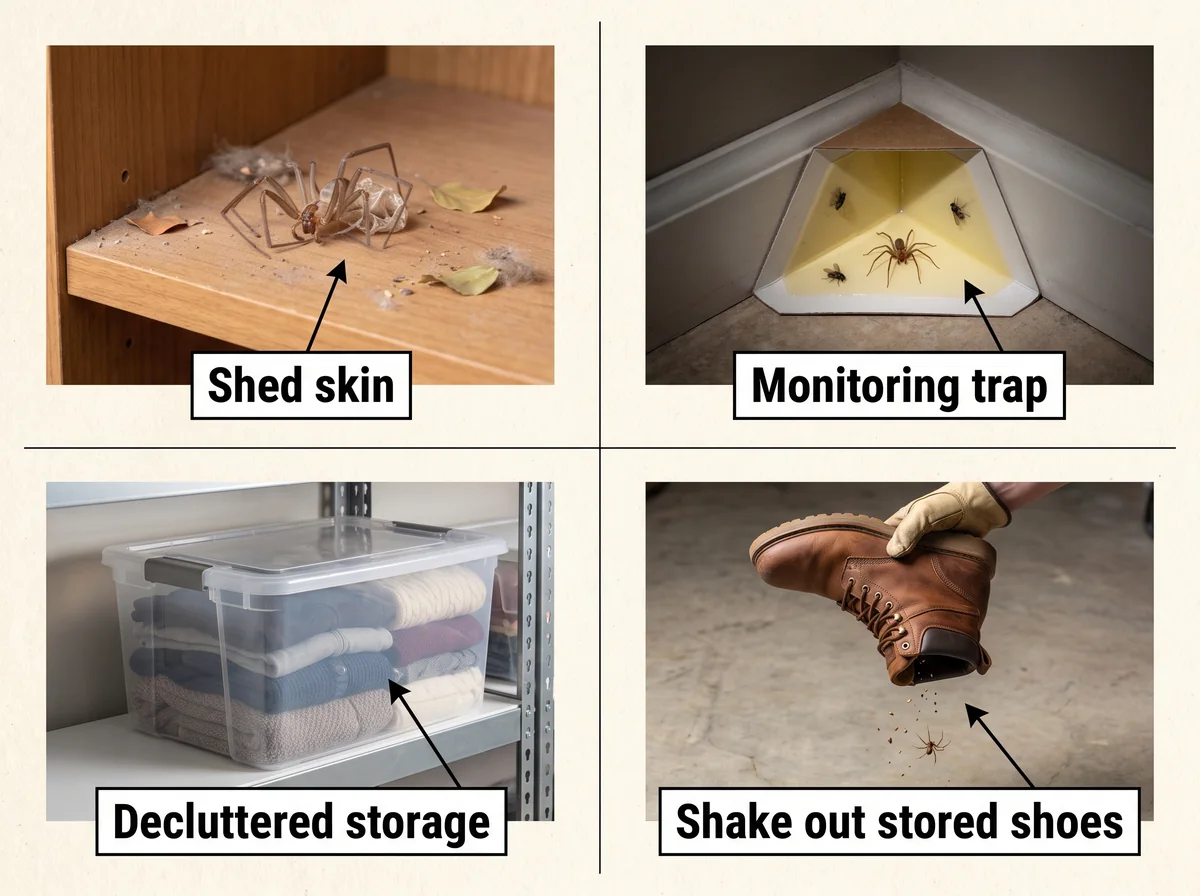
Quick identification facts
Storage Safety & Prevention Checklist
Use this practical check to evaluate your storage safety habits and identify physical precautions to reduce accidental contact with brown recluse spiders.
Why Should You Shake Out Stored Clothing and Footwear?
Brown recluse spiders seek secluded, quiet voids to hide during daylight hours. When garments, work boots, or seasonal coats hang in dark closets or sit inside storage bins for months, they create an attractive shelter. These spiders do not aggressively hunt humans; instead, almost all bites happen when a spider gets pressed against your bare skin inside folded cloth or a shoe.
You can disrupt this danger by making a deliberate habit of shaking out stored clothing, work gloves, boots, and extra blankets before use. Give your shoes a vigorous tap upside down on the floor before slipping your feet inside. Unfold stored blankets and shake out jackets completely so any hiding spider drops away rather than getting trapped against your body.
Store your everyday footwear and frequently used work gear in well-lit, elevated areas whenever possible. If you need to keep winter clothes, camping gear, or outdoor gloves in your basement or garage, seal them inside airtight plastic containers. This physical barrier stops spiders from crawling into folds while your gear sits undisturbed between uses.
You can check the same detail against Brown Recluse Bite Treatment: What Should You Do?.
How Does Reducing Storage Clutter Protect Your Home?
Cardboard boxes, stacked papers, and disorganized floor clutter provide hundreds of narrow gaps where brown recluses can hide undisturbed. Because these spiders prefer quiet and dry spots, storage areas like basements, attics, and closets often accumulate ideal hiding places. The more items you have stacked directly on floors, the harder it becomes to notice spider activity.
You can reduce hiding opportunities by clearing out unnecessary boxes and keeping floor perimeters bare across your storage rooms. Replace corrugated cardboard boxes with smooth plastic bins that have tight-fitting lids. Spiders struggle to climb smooth plastic surfaces and cannot squeeze past properly sealed container rims, keeping your stored possessions completely isolated from pest activity.
Keep your shelving units slightly away from walls to eliminate tight contact points that spiders use for pathways. Vacuum along your baseboards, closet corners, and behind stored furniture regularly to disturb developing hiding spots. Maintaining open space and orderly storage makes your living areas far less attractive to secretive arachnids seeking shelter.
You can check the same detail against Signs of Brown Recluse Infestation: What Should You Look For?.
If you want a second reference, Insectio’s brown recluse bite page covers the same topic from another angle.
Why Should You Make Noise or Vibration Before Reaching In?
Reaching blindly into deep storage bins, dark corners, or undisturbed cubbies carries the risk of accidentally pressing a resting spider. Brown recluses are non-aggressive and prefer fleeing from disturbances whenever an escape route exists. A defensive bite occurs when a hand pins the spider against a surface before the animal has time to run away.
You should tap firmly on storage boxes, rustle shelves, or create physical vibration before reaching your hands into dark, unlit spaces. This brief warning gives any resting spider a chance to retreat deeper into the recess or drop out of reach. Pair this vibration technique with a reliable flashlight so you can clearly see the void before placing your fingers inside.
Wear heavy leather or rubber work gloves whenever you handle long-stored lumber, firewood, or neglected boxes in your garage. Protective gloves add a dependable physical layer between your skin and sharp objects or resting spiders. Taking these few seconds to alert and inspect your workspace protects you during seasonal cleanouts.
This also connects with Brown Recluse in Your House: Why Is It There?.
What Physical Features Help You Confirm a Brown Recluse?
If you spot a spider while cleaning storage areas, checking key physical traits helps you verify whether it is actually a brown recluse. Adult brown recluses have six eyes arranged in three pairs, called dyads, set in a gentle semicircle across the head area. This unique eye pattern distinguishes them from most common spiders, which typically possess eight eyes arranged in two rows.
You can also look for a dark violin- or fiddle-shaped marking on the spider's cephalothorax, with the neck of the violin pointing backward toward the abdomen. Keep in mind that this marking can vary in contrast and may look fainter on immature spiders. Therefore, looking closely at the eye pattern remains the most reliable visual test for true identification.
Observe the coloring on the spider's abdomen and legs as an additional field check. A true brown recluse has uniformly colored legs and an unpatterned abdomen ranging from tan to dark brown, completely free of stripes, bands, or spots. Its long, thin legs are covered in fine hairs rather than thick, conspicuous spines found on look-alikes like wolf spiders.
For another part of the identification, open Brown Recluse Web Identification: What Does It Look Like?.
When Should You Call a Professional for Pest Management?
Routine personal precautions significantly lower your bite risk, but discovering multiple spiders across several rooms signals an established population. Brown recluse spiders maintain secretive, reclusive habits that make total elimination challenging using basic household cleaning alone. When spiders hide deep within wall voids, subfloors, or crowded attics, standard sprays often fail to reach their harborage.
You should contact a professional pest management specialist whenever you confirm breeding recluse activity or repeatedly find specimens in living spaces. Experienced pest technicians understand the species' behavior and can apply targeted management strategies designed specifically for elusive indoor populations. Professional intervention provides systematic monitoring tools that track pest reduction over time.
Continue practicing your personal prevention habits while professional treatments take place. Keep shaking out your clothing, pulling your beds away from walls, and keeping bedskirts off the floor so wandering spiders cannot climb up. Combining steady personal vigilance with specialized pest management delivers the safest long-term protection for your household.
You can check the same detail against Brown Recluse FAQ: What Do People Ask Most?.
Related identification guides
Brown Recluse in Your House: Why Is It There?
practical indoor inspection to confirm or rule out presence
harmBrown Recluse Bite Treatment: What Should You Do?
find evidence-based first-aid and medical-care steps
signsSigns of Brown Recluse Infestation: What Should You Look For?
determine whether multiple spiders/an established population is present, and next steps
signsBrown Recluse Web Identification: What Does It Look Like?
identify a spider by its web structure
Frequently asked questions
Why do brown recluse spiders hide inside clothing and shoes?
Brown recluse spiders naturally seek out dark, dry, and undisturbed spaces to rest during daylight hours. Folded garments, work shoes, and storage boxes mimic the quiet cavities they prefer in nature. When your gear sits unmoved on a closet floor or in a basement corner, a wandering spider can easily crawl inside for shelter.
Can moving my bed away from the wall help prevent bites?
Yes, moving your bed a few inches away from walls and removing hanging bedskirts prevents spiders from wandering onto your mattress. Brown recluses climb rough surfaces, and bedding touching walls or floors creates an easy bridge. Keeping sheets tucked in and elevated prevents accidental contact while you are asleep.
What is the most reliable way to identify a brown recluse you find?
The most reliable diagnostic feature is the eye arrangement: six eyes grouped into three pairs across the head region, rather than eight eyes in two rows. You can also look for a violin-shaped mark on the cephalothorax and uniform, unbanded legs covered only in fine hairs without heavy spines.
Why is professional pest control recommended for severe recluse infestations?
Because of their secretive habits, brown recluses often live deep inside wall voids, attics, and dark structural gaps where regular household measures cannot easily reach them. Professional pest management professionals have access to specialized methods and monitoring tools designed to locate and treat established, hidden indoor spider populations safely and effectively.