Quick identification facts
Physical Trait Checklist
Use these observable physical traits to check whether a spider matches the verified field marks of an adult brown recluse.
How Can You Check the Eyes First?
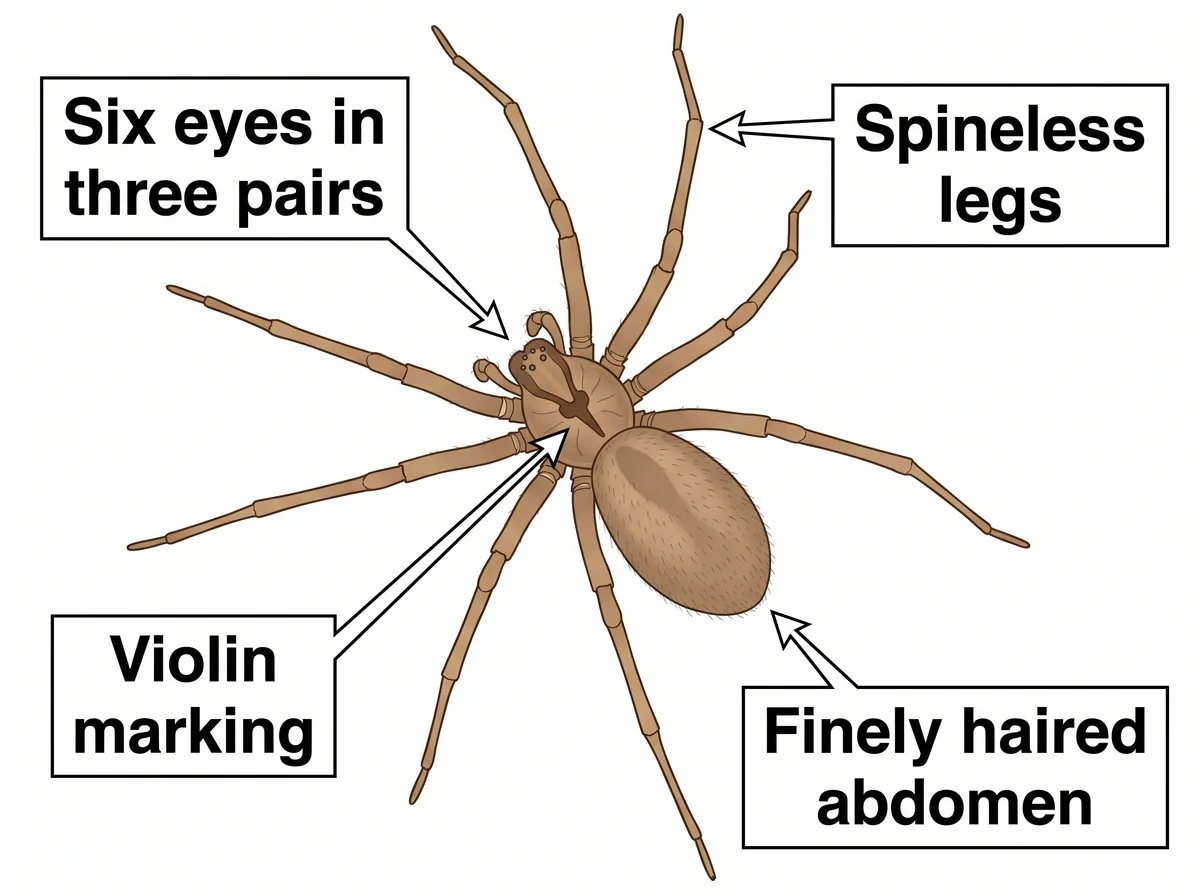
The eye arrangement is the most dependable physical feature you can use to identify this species. Most spiders you find around buildings have eight eyes grouped in two horizontal rows across their face. A brown recluse has only six eyes, which are set in three distinct pairs called dyads.
You will see one pair positioned centrally at the front and one pair on each side, forming a clear semicircle. Because these eyes are relatively small, you will usually need a magnifying lens or a clear, close-up photograph to count them properly. Checking this pattern helps you quickly separate a brown recluse from ordinary household spiders.
When you look closely at the head region, notice how the three pairs sit spaced apart along the curve. This unusual eye pattern remains constant across all stages of development, making it far more reliable than surface colors. If a spider in your home has eight eyes, you can immediately rule out a brown recluse.
A related clue is covered in Brown Recluse Size: How Big Is It?.
What Does the Violin Marking Look Like?
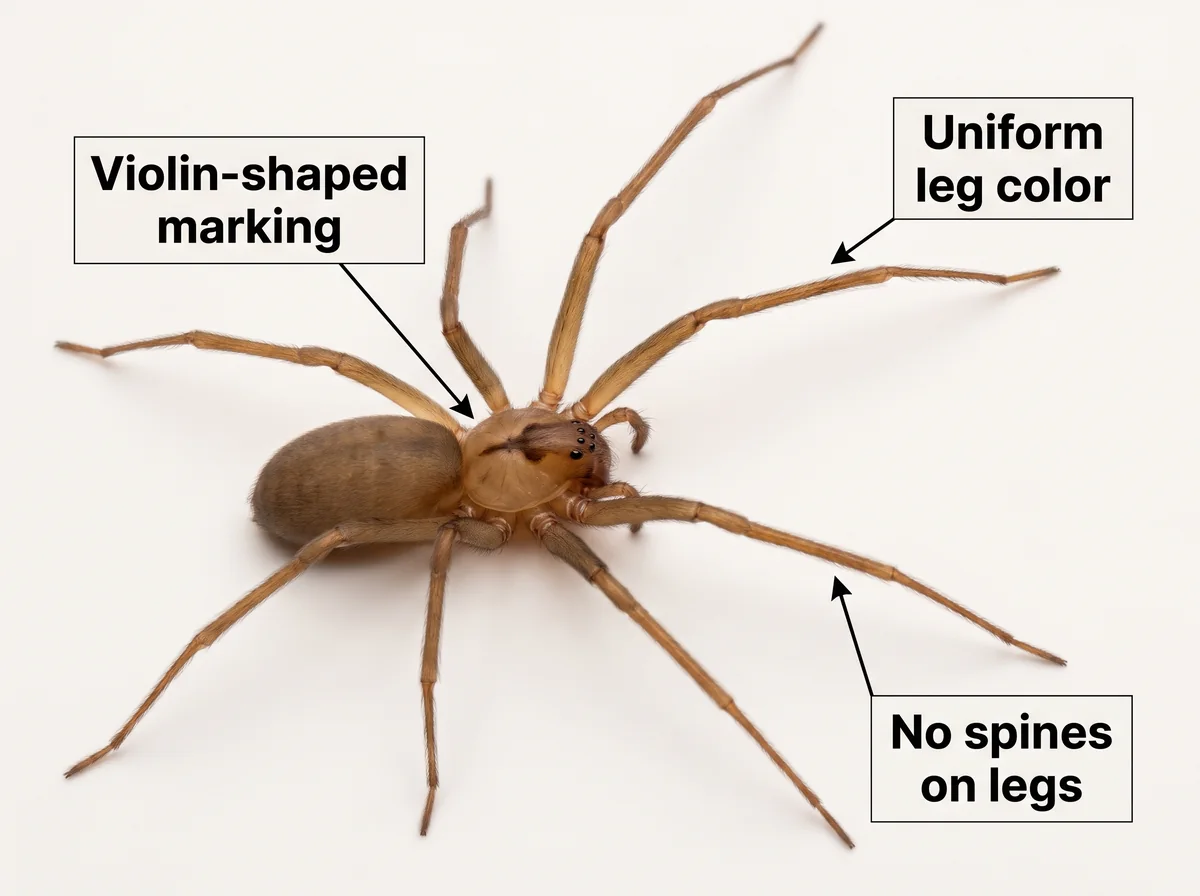
The dark violin or fiddle pattern sits on the top surface of the cephalothorax, which is the front body segment. The widest part of the marking surrounds the eyes at the front of the head. From there, the narrower neck of the violin extends backward, pointing directly toward the spider's abdomen.
This marking usually shows a distinct dark brown color that contrasts against the lighter tan background of the body. However, the contrast of this shape can vary significantly between individual spiders you encounter. Younger spiders often display a much fainter pattern, which can make the shape harder for you to see clearly.
Because background shading varies, you should never rely solely on the fiddle mark to make a final confirmation. Other species occasionally carry faint dorsal shadows that look similar to the untrained eye. Always pair your view of the violin mark with a careful check of the three eye pairs before drawing a conclusion.
You can check the same detail against Brown Recluse Web Identification: What Does It Look Like?.
To compare this detail with another source, Insectio’s brown recluse appearance page offers a useful cross-check.
Why Is Uniform Color on the Legs and Body Important?
A true brown recluse displays an entirely uniform coloration across its entire body and legs. The overall shade ranges from light tan to deep brown, but it never features mixed colors or intricate designs. You will never see mottling, rings, distinct spots, or alternating bands anywhere on its body.
The abdomen is oval and smooth, matching the neutral palette of the rest of the spider without any chevron patterns or light patches. If you find a specimen with bright patterns, bold spots, or multicolored rings, it belongs to an entirely different family. Checking for solid color is one of your fastest visual filters.
This solid appearance also extends down the length of every walking leg from the base to the tip. Inconsistent leg shading or banded joints immediately signal that you are looking at a different spider species. Examining the overall consistency of the tan or brown tone will keep your visual inspection accurate.
For the next useful comparison, see Brown Recluse Look Alikes: What Could It Be Confused With?.
How Do the Legs and Hairs Appear Up Close?
The legs of an adult brown recluse are noticeably long, slender, and uniformly colored from joint to tip. When you inspect them closely under good lighting, you will see they are covered entirely in soft, fine hairs. These microscopic hairs give the limbs a smooth, silky texture rather than a bristly outline.
You will not find heavy, conspicuous spines sticking out at sharp angles along the leg segments. Many common wandering spiders feature thick, dark quills or visible thorns along their limbs that stand out immediately. A brown recluse lacks these jagged spines, keeping a very delicate, sleek leg profile.
Take note of how the spider holds its limbs when resting or walking slowly across a flat surface. The long, thin legs spread out evenly around the compact body without thick, muscular joints. If you spot thick, heavily armored, or visibly spiked legs, you can safely eliminate the brown recluse.
You can check the same detail against Baby Brown Recluse Identification: What Does It Look Like?.
How Big Is an Adult Brown Recluse?
The body length of an adult brown recluse measures roughly 1/4 to 1/2 inch, which translates to about 6 to 11 millimeters. This measurement covers only the head and abdomen, leaving out the span of the legs entirely. These spiders remain relatively compact rather than massive.
When you include the fully extended legs, an adult brown recluse spans roughly the diameter of a standard U.S. quarter. Females are generally larger and fuller in the body than their male counterparts. Adult males are typically about half the size of mature females, giving them an even smaller, lighter build.
Immature spiderlings share the same general body proportions and delicate leg structure as fully grown adults. However, these younger spiders display a distinctly lighter coloration and may have less visible violin markings. Remembering the quarter-sized footprint will prevent you from confusing large, heavy-bodied spiders with a brown recluse.
You can check the same detail against Brown Recluse vs Wolf Spider: What's the Difference?.
Related identification guides
Brown Recluse Size: How Big Is It?
understand actual dimensions and scale
comparisonBrown Recluse Look Alikes: What Could It Be Confused With?
broadly identify which other spiders get confused with a brown recluse
appearanceBaby Brown Recluse Identification: What Does It Look Like?
identify a juvenile/spiderling specimen and understand its risk
signsBrown Recluse Web Identification: What Does It Look Like?
identify a spider by its web structure
Frequently asked questions
Can you identify a brown recluse by the violin mark alone?
You should not rely on the violin mark alone to identify a brown recluse. The contrast of the marking varies widely between individuals, and younger spiders often have very faint or indistinct shapes. Several harmless spiders also feature dark markings on their head area. To confirm the identity accurately, you must always look for the six eyes arranged in three distinct pairs alongside the violin pattern.
Do brown recluse spiders have stripes or bands on their legs?
No, a brown recluse never has stripes, bands, or rings on its legs. The legs are completely uniform in color, matching the light tan or dark brown shade of the main body. They are covered in tiny, fine hairs without large, conspicuous spines. If the spider you are inspecting has dark and light bands across its leg joints, it is definitely not a brown recluse.
How many eyes does a brown recluse have?
An adult brown recluse has exactly six eyes. This is an unusual trait, as most common spiders have eight eyes arranged in two straight rows. The six eyes of a brown recluse sit in three separate pairs, called dyads, forming a distinct semicircle across the front of the head. You will typically need a hand lens or a clear photograph to inspect this pattern.
How large is a brown recluse when resting with legs spread?
With its legs naturally extended, an adult brown recluse is roughly the size of a U.S. quarter. Its central body measures only 1/4 to 1/2 inch in length, or about 6 to 11 millimeters. Mature females have a larger, stouter body, while adult males are generally about half that size. Exceptionally large, bulky spiders found in homes are usually look-alike species.